Writing

Nonfiction — “Geography and Centipedes”

Today, I had a rather innocent and ill-informed student inspect an atlas on the wall (one with only the boundaries of countries but no printed names), point to Cambodia, and say, “I think that’s South Koran.”

He meant Korea.

I asked him if he was 100% sure and he said, “Well, no, because I thought Korea was near the Middle East.”

“No,” I said, pointing to Africa, “It’s closer to East America, although Middle-Earth is between them.”

“Oh! I should have known that.”

“And across the ocean is the United States,” I said, pointing at Greenland.

“Next to Russia,” I pointed at Canada. The student screwed up his face in confusion (was something finally getting through?), and I added that “the map’s upside down.”

We had fun, I corrected the mistakes, and we moved on.

Later, someone made a disgusted snort at a mention of The Human Centipede (I didn’t bring it up, someone else did). My student, perceiving injustice, protested. “Human centipedes are cute, too! All bugs are, even if you don’t like how they look.”

We (that is, the class) quickly surmised that he didn’t know what we were referring to, and so we stalled at a certain crossroads. We wanted to reveal to him his ignorance on the subject, to enlighten the little fellow, but we didn’t want to corrode his innocence. The human centipede is a concept contrary to decency and goodness. It embroils oppression and futility and the depravity of man’s imagination into a singular, iconic combustion.

Instead, we tiptoed.

“We’re not talking about a bug, exactly.”

“It’s a way… for people to get together.”

“It’s like a team building exercise.”

“It’s not a sexual thing,” someone assured him.

“Is it hard to do?” he asked.

“Not if you have the right attitude.”

“It’s exhausting.”

“Is there also a human caterpillar?” he asked.

“No, no, no.”

A human caterpillar made me think of a human cocoon, and I shuddered at the image of a wet sack of living, struggling flesh. For a moment I envied the know-nothings and little-minds, only to think that really, the degree of distinction between myself and this student was relatively minor, only I’d been shielded from the world’s true evils by Rated R movies and shadow-images, cloistered in a school that looked like a prison, secreted into a suburbs with invisible but tangible walls, as ignorant of greater powers and principalities as a centipede, its face turned ever-downward in its small, contained clamor.

Writing

Fiction—Post Post Post

INT. CLASSROOM

STUDENT
What if I wanted to write how John Milton’s Satan is a post post-modern hero? Would that still be within the limits of the assignment?

PROFESSOR
Are you asking me if you can write a paper on John Milton’s Paradise Lost in a “Scholarship in the Last Fifty Years” course?

STUDENT
But I’ll be using Bourdieu as a discursive lens.

Professor looks at Student wryly, then sits on the desk in front of him.

PROFESSOR
How about I answer your inquiry in the form of a story? You see, when I was thirteen, there was an essay-writing contest put up by the Food and Drugs Administration. The first place winner received $50, which back in 1976 had about the same buying power as $213 and nine cents.  The prompt was something like what is the most American pie? I wanted to argue for chicken pot pie, but I wasn’t sure that it qualified, or if they were just looking for dessert pies. So I sent the FDA a letter asking for their definition. What were the exact degrees of distinction between a pie and other pocket pastries? And you know what happened?

STUDENT
What?

PROFESSOR
My parents died. I had to become man of the house. Started working two jobs and put my siblings through college. They all think I’m their father. They call me Dad. Or Papa Bear.

STUDENT

PROFESSOR
I tell them I’m not your father. I’m your little brother, Colin. But they won’t listen. Do you get me?

STUDENT
I think so. Yeah.

Professor pats Student on his head, affectionately. There are tears in his eyes.

PROFESSOR
Derek.

STUDENT
Yeah, Dad?

PROFESSOR
Never mind.

Writing

Some art captions for Magic The Gathering

Art by Jason Chan. / Dark cool colors draw attention to a beautiful solar eclipse and the silhouette of a crouching vampire. The card creates the sensation of size and seclusion. / A nighthawk is a nocturnal bird that feasts on flying insects. The bird has similar white bands on its wings to the vampire’s ritualistic face paint. / The card also references Edward Hopper’s “Nighthawks.” Note the similarity between the vampire shaman and Hopper’s bartender.


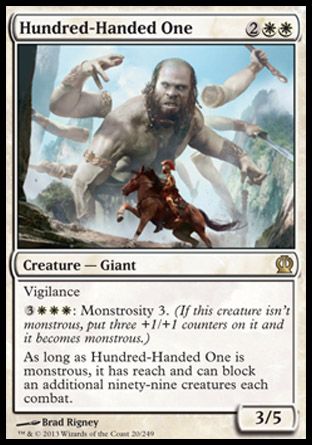
Art by Brad Rigney. / An overlapping rider and distant fog creates epic depth. The axis moves the eye to the brutish face with quick trips to admire the Greek’s heroic energy. Photorealism makes the giant’s presence more dangerous. / The giant refers to Hekatonkheires, or hundred-handed giants. His disembodied arms and marble color allude to limbless Greek statues. / Sleek golden armor conflicts with the giant’s Oriental braids, jewelry, and nearly-nude body. A well-constructed culture clash.


Art by Adam Paquette. / Nice complementary blues, browns, and some purple. Cropping hints at the whale’s immensity. The ships’ overlap creates scale. Note the whale’s size is increased further when the viewer notices the 2nd schooner. / The mechanics complete the card’s theme. The whale swallows you, and you only escape from the ‘belly of the beast’ after the creature has died. / Refers to Herman Mellville’s “Moby Dick,” and the Biblical story of Jonah. For some infotainment, google Leviathan melvilleiis.


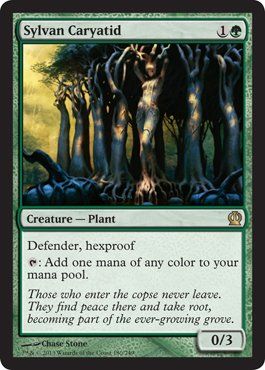
Art by Chase Stone. / A sculpted female body that lacks human detail creates an eerie and forlorn sense of loss. The artist has carefully retained her sexual energy while she transforms into a tree. However, her sylvan companions would suggest that this too will disappear. There is danger here related to the perils of the lotus eaters. / A caryatid is Greek pillar sculpted into a female figure. 


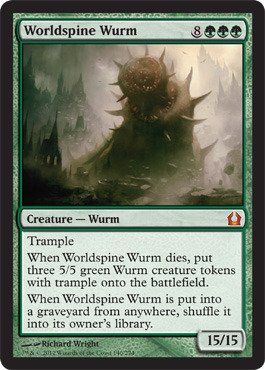
Art by Richard Wright. / A canvas of hazy mountains create scale. The spines are cool and separate the wurms visually. / Having the wurm rise destructively over the city might be influenced by riftworms in Gears of War. The wurm anatomy seems inspired by Ridley Scott’s alien with its pharyngeal jaw and toothy tongue. / ‘Worldspine’ is vertebrae made from the earth. This creature makes its habitat in deeper regions of the planet. 


Art by Ryan Pancoast. / The card’s mechanic is very flavorful. The golem has been immobile through ‘the ages’ but will become a terrible adversary if provoked. / To add scale, the golem jaunts over a heavy forested canopy. The tilted perspective disadvantages the viewer and increases the golem’s physical might. / Its outfit is a fantasy-variant of Egyptian war dress and linen head covers, evoking lost empire. The swords might be inspired by Soul Caliber. 

Writing

Poem — “A Cigarette on the Beach”

A cigarette on the beach:

Cold,

Light-headed,

Salty,

Composed.

You inhale with the coming of the waves;

You breathe out as they slip away.

The drowsiness you feel is the cooling of the earth

as it spins through a universe of cold, salty thoughts.

The embers in the stub are little suns.

You flick away a shooting star

and know at once how small you are.

Writing

Fiction — “Raymond Clem”

I hadn’t thought about the letter in years. It wasn’t until I was at the MoMA a few days ago that I saw a name that reminded me. Mallick Clem. It was an inscription on the wall. Mallick. Clem. The installation itself had not been substantial. Mallick had starved a cat to death in a bucket painted like a can of tomato soup. The Warhol reference I got, but the poor cat? I guess I just don’t understand modern art.

The name Clem, though, rattled awhile in my synaptic nerves. Then it came back to me. That curious incident with the letter. Clem! That had been the addressee. One Raymond Clem.

Continue reading

Writing

Fiction — “That Chevy Impala”

I will never forget it. Blue as the Kelley Blue Book, a proud white belt, dual headlights like plates on display and squinting taillights. It made salesmen use the word “aerodynamic” and “chrome” and its interior looked like the cockpit of a rich man’s bush plane.

We (the neighbor’s kids) would touch its windows with our faces when the owner wasn’t looking. I told Nana someday I would own that car, that very car, and she tsked me: “No one wants you driving around in an Impala.” That’s when I noticed the dirty trucks littering the street like beer cans.

Something happened, or maybe he sensed evil thoughts. A For Sale sign appeared in the windshield, and the next day someone keyed the car. I still remember the owner touching the scars as if they were still sore. “You don’t see us driving nice cars,” Nana said, watching the street, and now I knew why. 

Writing

Fiction — “Fale/Fail”

The room was used for secular reasons. Union meetings, pro-dev seminars, documentary screenings, a Women’s Book Club. One day out of the week, however, the room became a sacred space – one of those churches you see packed in with animal hospitals and loans offices in a mall strip beneath the knees of a freeway. This church didn’t have block letters above its door announcing “The Church of the Risen Christ” or “Corner Ridge Pentecostal Assembly” or “All Faiths Ministry – Our Service is Heavenly!” Instead, block letters read “Community Center” and offered a 25% discount on weekends.

The church met Saturdays. Its congregation were Pacific Islanders from Samoa or some other island. Whatever it was, if you confused the family with a neighboring island like Tonga, they would curse you lightheartedly in their language, either Samoan or Tongan. Most of them weighed four hundred pounds; their cells, which had found clever ways to store energy on long journeys at sea, had not adapted well to America’s heart-stroking, hip-expanding eating patterns. Still, they laughed.

We knew about the family since they would come by Depression Alliance (we met on Tuesdays after Bingo Derby). We’d eat their coconut rice and joke about turning our meetings into Overeaters Anonymous, although we were a little unsure about the Pastor, at least until he revealed he was having trouble finding women. Someone said to try the zoo and we laughed – a connection made, some raw commonality.

Continue reading