Life, Writing Process

Comicpalooza 2018 — Writing Unforgettable Characters

I went to a literature panel entitled “Writing Unforgettable Characters” featuring Bonnie Jo Stufflebeam, Joe Lansdale, Carrie Patel, and Bev Vincent.

Well, Joe Lansdale kind of took over the Q&A in the best way possible. The others had some insights, but Joe exuded this pragmatic writing presence. A manuscript messiah miasma. Predatory parable pheromones.

A few of his best points:

  • The writer gives 50% of the story. The reader brings in the rest.
  • Some think character is giving someone a cane or an eye patch. That if they’re from Mars or were raised by Indians, they’re interesting. Don’t confuse oddity for character. When writing character, you need to think of motive. Why they do stuff. There’s Surface Motive. What they tell themselves is their Motive. And True Motive.
  • Characters must intrigue. They don’t have to be likable, just interesting.
  • When writing, there has to be music in the prose. Otherwise you’re just lining up turd after turd. Hemingway had a masculine poetry. Fitzgerald had a magical poetry. Learn how to combine rhythm, style, and character into the poetry of prose.
Writing Process

Creating the Logo & Mascot for Rune Bear

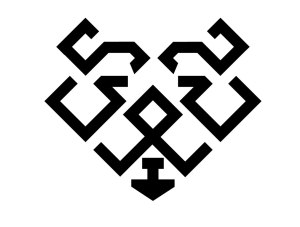
Phil Kiner has always been my go-to guy for visual marketing, so when I started Rune Bear, I had constant reassurance that the logo would end up looking awesome. And, indeed, I ended up with this:

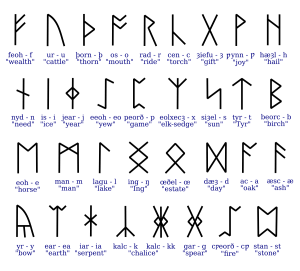
But that wasn’t the first rune bear that Phil designed. Phil also experimented with configurations based on actual runes, specifically Elder Futhark (c. 150–800 AD).

A futhark is a type of alphabet that starts with some variation of F, U, Þ, A, R, and K, and Elder Futhark is the earliest known form. The alphabet was used by Germanic tribes during the ‘Barbarian Invasions’ (the Germans have a better word for it—Völkerwanderung while English academics have a more boring description—the ‘Migration Period’) which may or may not have led to the fall of the Western Roman Empire. Today, Elder Futhark is often found on old weapons, amulets, tools, and, yes, this is real life, runestones scattered across the European landscape.

Phil sent me three designs based on the futhark.

The first:

While I loved the diamond nose and frumpy grin, the ears, while stylish, gave the bear an undesirable ant-like quality.

The second:

The test market (me) liked the sideburns but thought the bear looked too grumpy.

The third:

#perfection

For a while I had settled on this design for the magazine.

But there was still this itchy inkling (writer’s rash?) in the back of my mind. I wanted something that would allow other artists to create their own variations. And something more blue, more realistic. My attempt looked like this:

No, wait, that’s something else.

My first design was this:

In his mouth I wanted the futhark word “alu” (ᚨᛚᚢ). The alu’s meaning is a contested issue, but some of its definitions hint at a strange, disturbed state created by sorcery or induced by ale (we’ve all been there). It is usually inscribed on artifacts of magical or mystical import. Other potential meanings include “taboo,” “strange,” “distraught,” and the “world between the living and the dead.” (I also considered ᛒᛖᚨᚱ, which is the word “bear” spelled out in futhark letters.)

In the end, Phil drew this:

… and the rest is rune history.

Writing Process

Strange, Surreal, Speculative, and Supernatural

Rune Bear claims to be a digital literary magazine dedicated to the Strange, Surreal, Supernatural, and Speculative.

We ordered the genres like that for the soft soil of sound; a sussuration as subdued as Robert Frost’s sound of sense. Sometimes alliteration is an aroma, an allure. But if we wish to sustain submissions, we’ll need to suss out exactly what we’re looking for.

Strange

By Strange, we mean Weird fiction, a subgenre of the speculative encompassing horror and tales of the macabre. Science, myth, and horror blend into stories which estrange the familiar, break the laws of Nature, and bring the reader into contact with madness. Ann and Jeff VanderMeer, editors of the incredible anthology The Weird, add that “With unease and the temporary abolition of science can also come the strangely beautiful intertwined with terror.” But Weird fiction is not necessarily terror-inducing. As Jake King explains “Weird Fiction is about things that aren’t just unknown, but essentially unknowable to humans. Given that we as humans fear the unknown, we usually assign it as horror, but it doesn’t have to be.”

Surreal

By Surreal, we refer to writing that tries to capture the wilds of the unconscious through irrational juxtaposition. André Breton, founder of the literary movement, defines the Surreal as a proposal to “express—verbally, by means of the written word, or in any other manner—the actual functioning of thought.” He adds that it’s an assertion of “complete nonconformism.” In this way, surrealism is better than realism—a rejection of the refined, a rapture of the raw. The bizarre, unreal, incongruous, paradox, and perverse are elements of Surreal, as well as thirty-six blue rabbit trucks.

Speculative

By Speculative, we mean fiction of the “what if?” As David Bowling describes, these are worlds “that could have been, or might have been, if only the rules of the universe were altered just a bit.” Often the grounding is in the sciences. Innovations or alternatives in psychology, sociology, biology, and technology lead to wild human problems and wilder solutions. In this way, Andy McCann describes, speculative fiction is “preparation for all futures”—an anticipation of infinite destiny. Ultimately, however, Steve Tully writes that the genre is “about you and me” (Lilly). The otherworld, be it magical or mechanical, is a testament to the human imagination, but also human reality.

Supernatural

By Supernatural, we mean fantasy, a genre of imaginative fiction. Sometimes there is a natural world, with the supernatural pressings against its edges. Sometimes the supernatural is the world; the rules of reality re-adapted to make-believe. Tolkien writes that fantasy “touches on or uses Faerie” which “may perhaps most nearly be translated [to] Magic—but it is magic of a peculiar mood and power.” Or, as George R.R. Martin writes, “Fantasy is silver and scarlet, indigo and azure, obsidian veined with gold and lapis lazuli. Reality is plywood and plastic, done up in mud brown and olive drab” (Perret). In this genre are epic, urban, high and low fantasy, fable, myth, steampunk, arcanepunk, a whole slew of other punks, and what Tolkien calls “the Perilous Realm.” We, of course, take all of the above.

References

Breton, André. Manifesto of Surrealism (1924). Ann Arbor :University of Michigan Press, 1972.

King, Jake. Weird Fiction Discussion Group. Facebook, 26 March 2018.

Lilly, N. E. “What is Speculative Fiction?” Green Tentacles, March 2002.

Perret, Pati. The Faces of Fantasy: Photographs by Pati Perret. New York: TOR, 1996.

Oziewicz, Marek. “Speculative Fiction.” Oxford Research Encyclopedias—Literature, March 2017.

Tolkien, J. R. R. Tree and Leaf (1939). New York: Harper Collins, 2001.

VanderMeer, Ann and Jeff. “The Weird: An Introduction.” Weird Fiction Review, 6 May 2012.
Life

Improv

I coach two high school Improv Teams down here in Sugar Land, Texas. We only go to one tournament—MIST at the University of Houston, which occurs in the Spring. Well, we’ve had a bit of a winning streak. This marks the third year in a row the boy’s have won first place. Girl’s won first last year. This year there was some infighting and drama, and we lost a few members, but the girl’s pulled through and won 2nd. I’m proud as a parent.

Scifi

Short Prose (Science Fiction Friction)

“The android was making them all uncomfortable with its Zelzer Stiff eyeing them from its hip.”

Read more of “A Zelzer Stiff.”


“Between two trees exploded into boulder stumps, Elemmírë raised a fist. Behind him, ten figures, barely visible above the gloom and bloom, dropped to their knees and scanned the street.”

Read more of “Garden War.”


“There’s always that one friend who sticks to the group like a discount sticker on a used book…”

Read more of “The Immortality Cube”