Scifi

Mudball

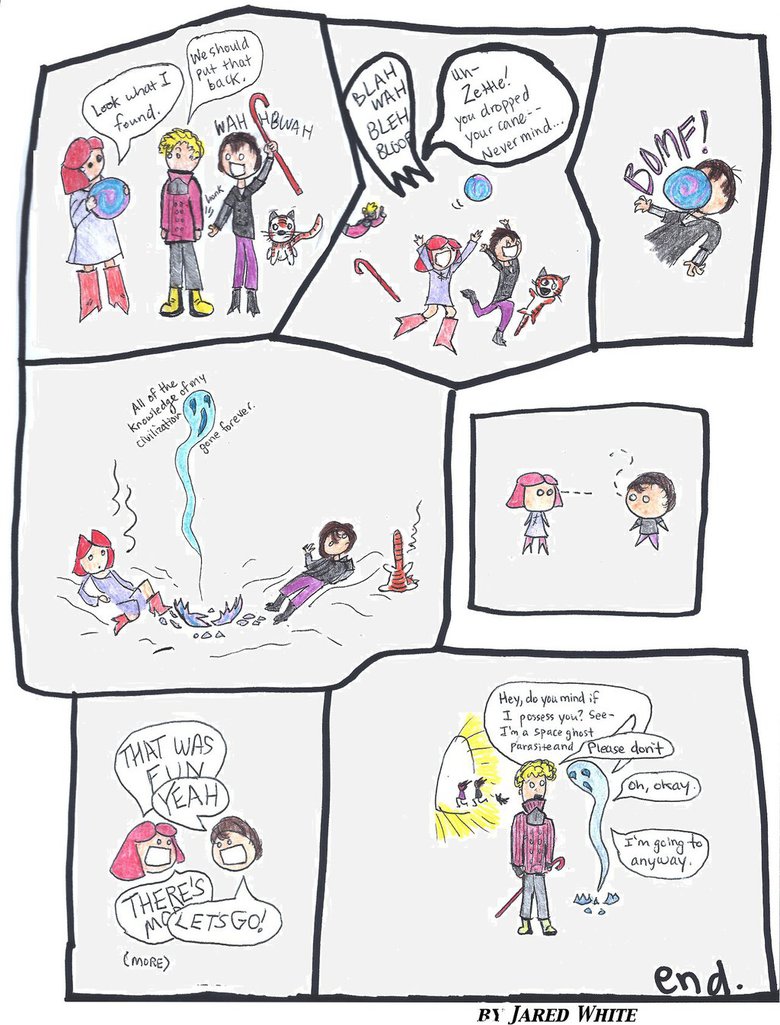
Eventually, GLADiators morphed into Mudball, an animated series pitch about children stranded on a distant planet. They would explore the ruins of a alien civilization from their downed spaceship while trying to find ways to contact their parents. Basically, Gilligan’s Island meets Lord of the Flies meets Carl Sagan meets TVTropes.

Here’s a quick comic starring Mae Bee (a tough, gruff ruffian of a girl), Zettle (a rash blind girl), and Nord (a neurotic, nervous boy):


Writing

Western — “Above the Snakes”

Leagues ahead, as if justification for the old man’s suffering, was a boat. How could refuge exist out here in the abandon? The red dust and crags. Would he find whale bone, and coral, and mermaid skulls, and impossible Lemuria?

He drew near the boat. A thing of wood and shadow, like a coffin, or a cradle. Beneath its keel, he said, I’ll lose them. Or maybe despair waited for dry bones to rest on canine prayers.

A starving Colt 45, unholstered. The storm-stained old man fingered pockets, finally slipping a solitary shell into the loading gate. It would probably end up lodged between his eyes before biting his pursuers. It’d been a long ride through the desert, and when the horse died, a long hike.

Continue reading

Scifi

Fiction — “Hot Spots”

The Boss slammed a slag of printed emails onto Gary’s desk, knocking over a picture of his wife.

“Pervert!” she shouted.

Gary froze like rugby players in the West Andes. This was exactly how he pictured a sexual harassment lawsuit beginning (although technically they began a little earlier, with the actual sexual harassment). But who was the prosecution? The women in the office intimidated him so badly he avoided speaking with them. Nor could the Boss be his offendee. She was less woman, more wyvern, with liver spots the approximate size and shape of actual livers.

The emails relieved him – temporarily. They were customer complaints, mostly exclamation marks and misspelled words, certain passages highlighted in salmonella pink. It was regarding the bridge.

“Thirty-two,” the Boss said on the verge of gargling. “Thirty-two complaints including a letter from the Chamber of Commerce regarding that damn bridge.”

Gary reviewed the papers. “Is it an instability problem?”

“Your bridge,” she said, “is putting sexy thoughts into people’s heads.”

Continue reading

Writing

Fiction — “Little Omens”

There were millions of diners, but Grandma Dee only cared for three. They were the breakfast buffet at the Country Village Senior Center, a small commissary, and an old Mom & Pop’s which after a lengthy annulment was now just Pop’s. Dee would assemble an exact dish of eggs and sausage and toast, order a side of bacon, then fold the bacon into her napkin for the cats.

It was usually up to me to navigate the conversation unless she had a newspaper, in which she found the poor guy at 7/11 who slit his throat or the latest development in privatizing the lake. Dee blended superstition with the rituals of life. A day without the eggs, without sausage and bacon, without newspapers, was a day that would go poorly.

So we were drinking coffee and sitting by the dusty windows at Pop’s, a lot greasier and sadder now that Mom was gone, on the verge of delivering three cats to an animal shelter to be put down at $25 a piece. Neither of us liked the idea of a cat ceasing to exist on our own initiative, but Dee’s backyard had become a breeding ground for gingery longhairs and they were marking and leaving litters. If they got in, they’d chew through bread bags and piss in discrete places. This hadn’t stopped Dee from tossing them cat feed and giving them the garage and, as mentioned, bringing them leftovers, but now that a county retirement was becoming a reality and Grandpa was gone…

“Grandma, you have any superstitions?” I asked while we paid the check.

“God, maybe.”

“Be serious.”

Writing

Fiction — “Where was Freud at Pompeii?”

A train stop and three occupants. The benches look like grills for our asses. I’m cooking. Temp is what? 99? 103? You can see the swelter in the air. It reminds you of the word “billowing” which is a ridiculous word. The heat’s cooking these benches, prepping my ass to be put on a patty. Train. In the distance. Tiptoeing towards us like bare feet on hot pavement. The blue rocks next to the tracks are shaking. The word clang comes to mind, which sounds like an ethnic slur.

INT. TRAIN

I’m huddled between a chubber in a tie and the meanest blonde I’ve ever wanted. The power lines and electric boxes zoom past – the industrial zones – the other trains – I could be the future. A mound of shatter zips past. Ragnarocks! I imagine a universe constructed with jigsaw pieces most of them lost. A blue spot here, a smiling red there, and gaps in the teeth. I wish the stars were a tapestry, the sun a boiled egg, this train the moon. I want to get out but I can’t (I’m stuck between animal and fiction). Instead barn doors swish, toilets go plunk!, and finally, finally, finally the next stop rolls up.

Creativity isn’t a disembodied head mulling through the multiverse: coldly indifferent, logical, wilting. Creativity isn’t a spade in hand, a pot the other. It can assimilate, steal, kill, and certainly rape. A square is a rectangle, but not. However, we forget that the circle is more natural, a pagan beauty. Creativity itself is not creating. It needs arms, legs, torsos, abdomens, stingers, hair. It’s not freedom, not prison. It walks behind your eyes, away from prying thoughts, below moving blades – where shadow is light. Creativity can be in the stocks and still be stronger. A shopkeeper who doesn’t sell, a werewolf who won’t bite. A rose that listens to the road and makes no sound.

Where was Freud at Pompeii? This train’s taking me to death.

Writing

Fiction — “Dulcinea”

[I wrote this story based on a prompt that a friend gave me: “What if your grandmother had super powers?” I tried my best to take this mediocre concept and turn it into something engaging. I failed. Here’s the messy result.]

The first thing Grandma did when she found she had super powers was beat up her son.

Dad had built walls around her in fits of helpfulness. He’d segregated her backyard with chain-link fences, here a horse pen, here a chicken coop, there pigs. A fence divided the car and the RV, a fence corralled the garden, a third formed an antechamber between the street and house. Then Dad worried about the clutter. Porcelain tea pots, trash bags of old acting costumes, a broken washer/dryer being used as an ironing board, memento pictures in memento picture frames. Every plastic memory. Better get rid of it.

He filled those jumbo storage containers. The ones you get from Staples. In one day, he shipped all her life’s savings to Salvation Army. He’d abused her when he had the advantage. Now the advantage was hers.

Continue reading

Writing

Fiction — “Kervani”

Could be a man or a six-armed cow or a twenty-headed sex goddess.

We can’t tell. There are too many Orders in the way. Too many black-and-white cloaks crinkling like choppy seas of newspaper.

The Orders go as follows: the Nine Apostles, the Elite Select, the Elite-Lite, the Demi-Elders, the Mystical Ring, the Phytes, and finally the endless serfs and smurfs and their bare-chested children and cattle. The Orders follow Kervani. We follow them. We, being Doug and Armani and myself, chafed and sun-scratched and willing to tour Hell just to get a snap of Satan.

They call us Iconoclasts but really we’re photographers, with every news outlet from here to Timbuktu willing to pay us the—eh? Doug just informed me that Timbuktu is two nations over. From here to Jakarta.

I’m thinking the sun’s fried their brains. If I said the world is flat, the earth is the center of the universe, sins build up in the pancreas, we should be bled from our livers to balance the humors, a little man operates the brain, animals compete to reincarnate into ghosts, blood makes the grass grow, I’d be locked in a padded closet. But the masses follow Kervani’s farts like they’re heralding a new age. They save his sweat in vials, listen to his speeches on audiobook.

Tourists, too, in faded green buses. Taking pictures of the shaking girls, skeptical, scandalized, complaining about the heat. The guides lead them in spiritual songs, trying to connect fanny-packed brains to the Order of Things. But mostly they can’t wait to return to five-star mattresses. Can’t blame them. Sometimes I’m tempted to follow along. Get a cheap hotel, a cheap girl.

Other times I have dreams of a different sort. I receive ‘the Cosmic Call.’ So does Doug. And the others. We all do. It’s like a whisper and an itch and a boner, and it’s supposed to be Kervani. The six-armed, twenty-headed sex cow.

We dwindle. I’ll find a camera, smashed, dust on the lens. Another convert. Those of us who remain hope to sneak the Vanguard, to rush the tent with the golden wool. An exclusive interview, a photo-op, a Q&A with Kervani looking like a mystic hobo in his sack robes (or her, lovely, in her coral pink scarf; or it, bleating sagely).

And maybe we have other reasons to make the hajj.

Instead, I take pictures, and wait, and wonder if God grew sick of Moses.

Life

Nonfiction — “Static Movement (Family)”

My parents are an amazing, oblivious people. After a quarter of a century, their clumsy attempts have ceased to be frustrating⁠—have, instead, slipped into the realm of ridiculousness. I hope I don’t come off as condescending. It’s just that through their undertaking to gratify my interests or reject them, I have been able to understand my parents as the loving, literal-minded, and culturally-stunted people they are.

Growing up, every experience had to be shared or rejected. If they couldn’t understand it, or if my younger siblings couldn’t take part, than my involvement was betraying the family’s interests. There was this notion that the family had to stick together, which is probably why I wasn’t allowed on sleepovers⁠—Dad and Mom couldn’t come.

And everything was shared, especially toys, even if it meant scratching all of my DVDs and scattering my legos between my siblings’ rooms. I was banned from watching television unless we were all watching it, and I didn’t care much for Fox News.

My bedroom had a window which looked into the living room. Or, from a more accurate perspective, my parents sitting on the couch in the living room could look into my room. My door locked from the outside.

Hiding in the restroom with a book became my escape from the ant colony. I was intrigued by the savor of stories, the sweet and sour taste of lies, the pasty sweet smack and blackened results of poetry, the prologue’s d’oeuvres and the epilogue’s bitter aftertaste. I began to regard my parents’ diet as having a sort of rot that their tongues, burnt, numbed or blunted by scriptural verbatim, could not detect.

For a long time I wasn’t aware of their literalism (paired, as it often was, with an unwillingness to participate in pop culture). I read The Hobbit, and enjoyed it, but wasn’t allowed to start Lord of The Rings because it was “unchristian.” (I did anyway.) But I could read Every Young Man’s Battle, the Biblical Art of War against masturbation.

Imagine my confusion when Dad recommended I read The Screwtape Letters. I was disappointed to find very little screwing.