
Writing Process

Naming Rune Bear

My hench-editors (it’s my wifeStuart, and his wife) and I kept rejecting names for a literary genres-remix website we were envisioning (and one poor guy had been building pro bono). For the longest time we had our fat hearts set on Idiosync (short for ‘idiosyncrasy’) but the title was too lazy and it sounded like ‘Idiot Sink.’ Then we wanted Idiot Sink, but that impulse didn’t last. AstroLack was too spacey. Los Orcus was too fantasy. We wanted less swords-and-sorcery and more swords-and-sandworms. No to Wyrdfic (is ‘weird’ gender-biased or something?), Grot Gear, Desmorious (I was down), Wristcanon (people would think we spelled ‘cannon’ wrong), Battle Droid (‘droid’ is trademarked by LucasFilm Ltd.).

For a while we settled on Rune Beard. We wondered if Nordic facial hair would evoke a space pirate captain firing plasma bolts at sword-wielding mechs on distant asteroids (it was the Warhammer 40,000 side of us that connected runes with sci-fi in the first place), but instead our test audience pictured a neckbeard playing WoW, and incidentally, they weren’t wrong. Dumping Rune Beard was emotional for me, because Alyssa, Stuart, and I had devised an awesome icon to accompany our logo—a bewhiskered Odinesque whose face was comprised of two Anglo-Saxon runes that corresponded with our initials (the scarred-eye is the jera, or j-rune, and my first name is Jared; the crooked nose is the sigel, or s-rune, i.e. Stuart). Being boys, we didn’t consider adding a rune for Alyssa.

Here’s Alyssa’s mock-up:
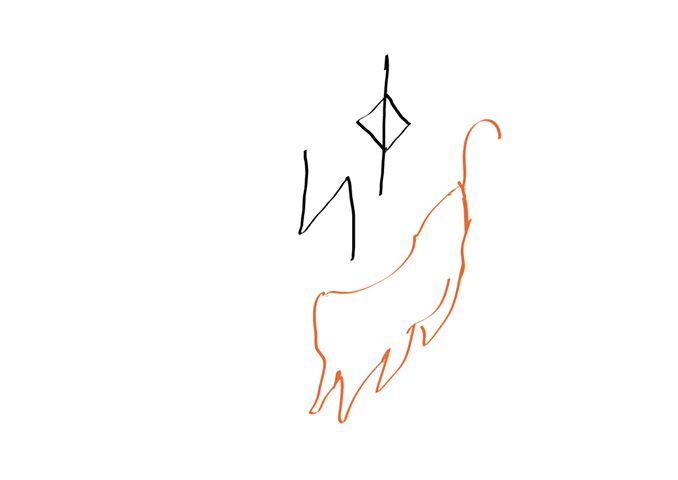
However, while I was pining over Rune Beard in my notebook, I noticed that without the “D” there was another great name for our mag—Rune Bear. The domain wasn’t taken, and there weren’t any rune bears out there except for the Runeclaw Bear in Magic the Gathering. The others were hesitant but the name grew on them. I went ahead and drew a rough sketch of what I was envisioning for the mascot. (Although these details weren’t in the sketch, I knew the bear had to be blue and have a rune in its mouth).

I finally turned to an old friend of mine, Phil Kiner, to create the mascot we have today:

Life, Writing Process

First post about Writ in Water

This past week I opened the submission period for Houston Baptist University’s debut literary journal Writ in Water. The submission period started on the 8th of November (i.e. on the same day as the US Presidential Election), will conclude on the 8th of February, 2017, and the journal will be published digitally on May 1st. Writ will be accepting short stories and poetry, and although the publication is affiliated with a Christian college, the submissions will not have to be religious in nature. Instead, Writ’s editorial board is seeking literature that combines good writing and the human experience.

Writ is the result of months of deliberate planning and meetings, but I have wanted to start a literary journal for a long time – since childhood, in fact, when I first read an issue of The New Yorker and wondered about the lives of editors-in-chief. When I began working as the Writing Coordinator of HBU’s Academic Success Center, I realized that my life goal could also benefit the college community, especially its emerging writers and artists. The Success Center, after all, doesn’t only serve struggling students with their grades – success comes in a variety of forms, including publication.

The Academic Success Center and HBU Administration were very supportive of the journal. My conflict was naming the thing. Trouvaille, which is French for a lucky find or discovery by chance, was considered, along with Numinous, a word that means a strong spiritual moment or the presence of divinity. But Writ in Water had three aspects which won out in the end:

Aspect One) On Mount Sinai, as recounted in the book of Exodus, Moses received two tablets of covenant law. These Laws were God-writ and therefore eternal. From this we have derived the idiom “nothing is written in stone” to signify that nothing else is permanent, perpetual, or predictable.

Aspect Two) The phrase “writ in water” comes from John Keats’ deathbed request to not include his name on his gravestone. Instead, the young feverish poet who “foresaw his death with brutal clarity” wanted only the mysterious line: “Here lies One Whose Name was Writ in Water.”

Aspect Three) The Bible, too, has a context for water, as God’s Word, as God’s Intervention, as the Holy Spirit. Isaiah 44:3 says that God will “pour out water on the thirsty lands and streams;” Corinthians 12:13 that “we were all baptized into one body… we were all made to drink of one Spirit;” and Jesus says in John 3:5 that “no one can enter the kingdom of God unless they are born of water and the Spirit.” Appropriate metaphors for a Baptist institution.

From these wells I draw my inspiration.

Reference

Stacey, Michelle. “Writ in Water: The enduring mystery of Keats’s last words.” The Paris Review, 23 February 2016.