Fantasy, Life, Scifi, Writing (Published)

Nominated — “And We Who Never Died”

The Tishman Review nominated my story “And We Who Never Died” for Best Small Fictions.

BSF is an anthology that honors the “best short hybrid fiction published in a calendar year.” The Harvard Review wrote that the pieces in BSF are like a “splash of ice water in the face,” a wake-up call to “your life… unspooling.”

When I heard I’d been nominated, I was like cool beans and moved on to lesson planning and grading.

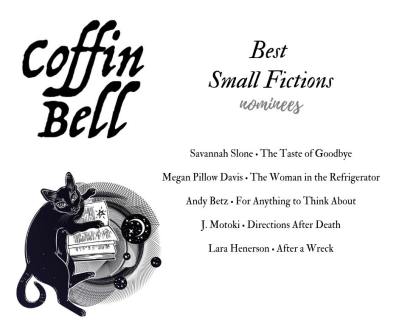
Then Coffin Bell posted this:
nomination

And I discovered that MY WIFE HAS BEEN NOMINATED.

As of this day, she and I are no longer friends. No longer best friends. No longer lovers.

But bitter enemies locked in literary combat.

THIS. MEANS. WAR.

Life, Scifi, Writing (Published)

Published — “Two Wings Flightless”

Kasma Magazine published my science-fiction short, “Two Wings, Flightless,” about a man who has to destroy a hovership that’s been solar-beaming the countryside. Kasma is a speculative magazine that publishes a story every first day of the month. Each piece is accompanied by a beautiful bit of art by Jose Baetas. You can see his treatment for my story above.

In “Two Wings,” I wanted to replicate the hero goes to a cave to slay a dragon story in a post-apocalyptic setting, switching the fire-breather for a flying war machine. The result was really fun to write, especially since the narrator was so dour and grit-happy. I’m already planning a sequel.

Life, Scifi, Writing (Published)

Published — “Good Fulch”

Good Fulch” is a story I’ve had in my head since high school. The premise is this. A society of robots have to decide if they should let a human live. The original draft was more human-focused; Charlton Heston shaking his fist at those “damn dirty CPUs.” But on a whim I switched the POV to the metal-heads themselves: glorious, dirty, regal, logical minds falling back on the xenophobia that once infected their creators.

The piece’s publication is Ripples in Space, a seasonal magazine devoted to “all things Sci-Fi, Dystopian, AI, [and] Space Marine.” It was the Space Marine mention that intrigued me, being an advocate for both Warhammer 40,000 and the works of Robert Heinlein.

“Good Fulch” features in this year’s Fall Selection.

Writing Process

Neil Gaiman, Cakes, and Writhing

Gaiman was the reason I always had purple baggy-eyes in elementary and middle school. The simplicity of his writings, the interweaving of mythology, monsters, and modernity, and the cruel world behind-the-magic offered my child-self something gripping, something utterly fantastic and appalling to explore late in the night. His writing still does—today—in my late twenties. Personally, my favorite work by Neil Gaiman is The Ocean at the End of the Lane (and not only because Fiction Beer Company has a citrus wheat beer inspired by the novel). I have a theory about literature (I’m allowed a few theories, being an English teacher) that great works must inspire the moral imagination, even if the wisdoms aren’t the sort we want to hear. In To Kill a Mockingbird, the title clues us in—Harper Lee wants us to understand that it’s a “sin to kill a mockingbird” for they “don’t do one thing but sing their hearts out for us.” The book indicts an American culture which regularly commits this sacrilege against its disadvantaged and minorities. In The Ocean at the End of the Lane, behind an incredible narrative about magic and outsiders, there is an abundance of dark truths about adulthood—its deceptive ontology of control, its routine mindlessness. Gaiman reminds us “Adults follow paths. Children explore;” “Nobody looks like what they really are on the inside;” and—in the most incredible line I’ve read in literature, something that explains the opus of Stephen King and H. P. Lovecraft better than they did themselves—that what marks adulthood is not some maturity or inner growth, but the awareness of how fragile the surface of our lives are, the recognition that reality is “a thin layer of icing on a great dark birthday cake writhing with grubs and nightmares and hunger.”

Fantasy, Life, Writing (Published)

Published — “Directions After Death”

This isn’t my achievement, but my wife’s. Coffin Bell has published J. Motoki’s “Directions After Death” digitally and physically in their first print issue. If anyone’s interested, the anthology, Coffin Bell: ONE, is available for preorder ($15). Per usual, I’m both horrified and impressed by my wife’s dark literature. Where I’m satirical and speculative, she’s weird and wonderful and clearly, clearly, the better writer.

Life, Writing (Published)

Published — “Cuidado”

Forgot to mention this when it came out. Life gets busy sometimes. One of my poems published at the end of August.

Rue Scribe is a magazine devoted to “Small Literature”—to “micro fiction, flash fiction, tiny fiction,” and to, eh, what the hell, “short shorts.” This cigarette drag of story is about the “small but powerful,” about the smoke that lingers. That’s why I’m honored RS chose to publish “Cuidado,” a poem condemning global violence on women through a life-changing encounter that lasts no more than five seconds.