Life, Writing Process

Kathleen Glasgow, Library Luminary

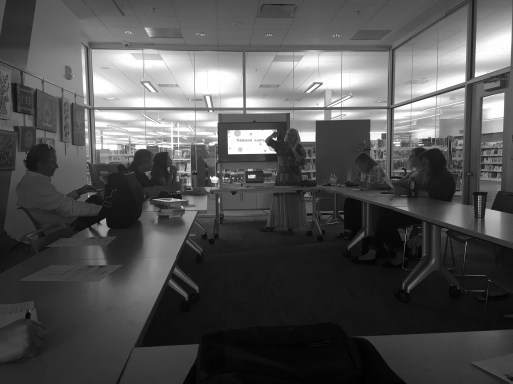
Kathleen Glasgow (of Girl in Pieces fame) swung by my school to speak about the dark places she’s been and the dark things she’s written.

Glasgow wore a black coat, a shirt reminiscent of prison bars, thick glasses, the kind writers wear. I felt bad for her. The air was insufferable. This time of year, Colorado has a pattern of snow days, but today the sun was out, the streets glaring, and the school hadn’t lowered the thermostat.

When she started, I thought she was about to ask if anyone had read Girl in Pieces. Instead, Glasgow asked, “Have you ever lost someone?”

So many students put up their hands.

“Do you know someone who self harms?”

More hands.

From there, her lecture sought to answer the question: What do you do with pain? With darkness? With feelings that hurt?

As you may not know, I’m a high school teacher, so I had to smile at my colleagues’ faces when Glasgow spoke about low grades, perpetual truancy, her expulsion and GED, drugs, alcohol, an early career at Wienerschnitzel and Jack-in-the-Box. And when she muttered “shit” into the microphone. Not exactly the narrative we impress on students.

Now, while she may not be a model of academia, to the nation of women falling and failing and hiding scars under long sleeves, Kathleen Glasgow is an avatar of hope—a sign that art and literature and the wondrous act of creation can salvage scraps, can save the soul.

But the answer wasn’t only art. It was the act of honesty. Of unwinding and expressing the truth without romance. “I write books for people who think help me help me help me,” Glasgow told us. “But say I’m fine, I’m fine, I’m fine.”

“People tell you—you’ll get over it, you’ll heal. Not true. You go on with the weight of that trauma for the rest of your life. You learn to be with it.”

“If I’m not going to be open about it, who’s going to be open about it?”

Her final piece of advice to the assembled classes, freshmen to senior, was this:

“Do not self-censor. Always believe in the story burning inside you. Write it. Rewrite it. Read as much as you can. Reading assists your sense for story, teaches structure. And never, never be afraid of the things you want to say.”

Writing Process

Writing Dialogue for the Elder Gods

lovecraft_god_dialogue

As a writer, how do you format the dialogue of an elder god?

This was the problem I faced while writing “The Elegy of Entrails,” a Lovecraft lovefest set on an extraterrestrial world.

Quotation marks felt too petty. You don’t say “What’s up?” to Cthulhu and expect “Not much” in return. Sure, the gods in Homer’s The Illiad speak like anyone else, but what about those things beyond existence? Creatures more dream than meat?

Continue reading

Writing Process

Carl Sagan on Books

François Boucher. Madame de Pompadour. 1756, oil on canvas, Alte Pinakothek, Munich.

Literacy is one of the great tools of civilization. Etymology is one aspect of this tool. Your ability to read my writing—another. The moral imagination invoked is a third. Unfortunately, writing is a recent invention—we’re still getting used to it. As Sagan notes in The Demon-Haunted World (335):

For 99 percent of the tenure of humans on earth, nobody could read or write. The great invention had not yet been made. Except for firsthand experience, almost everything we knew was passed on by word of mouth. As in the children’s game “Telephone,” over tens and hundreds of generations, information would slowly be distorted and lost.

Continue reading

Writing Process

Perrine on Escape and Interpretation

The first question to ask about fiction is, Why bother to read it?

Rembrandt van Rijn. Scholar in His Study. 1634, oil on canvas, National Gallery in Prague, Czech Republic.

Laurence Perrine, an English professor whose Sound and Sense textbook series was immensely popular, splits literature between escape, which helps us “pass the time agreeably,” and interpretive, “written to broaden and deepen and sharpen our awareness of life” (3). Escape and interpretation are not “two great bins, into… which we can toss any given story” but a scale with each inhabiting opposite ends (4).

Continue reading

Life, Writing Process

Failed — Desmorious

Every writer has several projects initiated with gusto, abandoned with reluctance. My first was a forty-page novel in middle school—a Lord of the Rings knock-off called The War of the Bowl. In high school, my friend Jon Ying and I devised a western desperadoes-and-dragons webcomic called Dustbound. In college, I wrote rough drafts and buried them in the rough. Even now, as I revise my novel, I fear its future in a back-folder on Dropbox.

Continue reading

Writing Process

Rune Bear Deviant

I’ve been photoshopping advertisements for Rune Bear‘s weekly posts. In each image I tried to capture some element of the companion piece while not making a picture that sucks terribly. Some have been not-so-great, as to be expected, but these three below were somewhat successful.

The first is a rune bear mounted on the wall for Amanda Bender’s “The Hero and the Hunter.” Her piece is part one of an emerging storyline (we’ll be posting Part II at a later date). Basically, a failing zoo has to turn to a big game hunter who pursues exotic beasts. But since Rune Bear Weekly features pieces that are under three hundred words, I’ll have to be careful summarizing anything, since the synopsis might end up longer than the story.

Look at those pain-sullied eyes. Look at ’em.

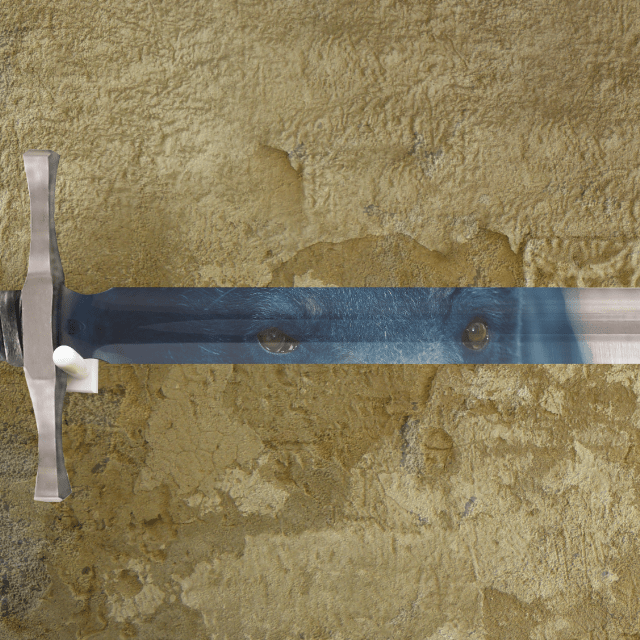
The second image is of a bear spying on himself in a sword blade. This was created for T. J. Locustwood’s “The Recruitment of Steel.” The piece is a cantos that pairs with his upcoming book, Alexander Croft and the Corvian Wrath.

Finally, for Joe Amaral’s “We are Seeds,” about a village destroyed and its sole vengeful survivor (a little girl with druidic magic),  I shopped a rune bear casting a leafy magical curse.

weareseeds2.png

Writing Process

Neil Gaiman, Cakes, and Writhing

Gaiman was the reason I always had purple baggy-eyes in elementary and middle school. The simplicity of his writings, the interweaving of mythology, monsters, and modernity, and the cruel world behind-the-magic offered my child-self something gripping, something utterly fantastic and appalling to explore late in the night. His writing still does—today—in my late twenties. Personally, my favorite work by Neil Gaiman is The Ocean at the End of the Lane (and not only because Fiction Beer Company has a citrus wheat beer inspired by the novel). I have a theory about literature (I’m allowed a few theories, being an English teacher) that great works must inspire the moral imagination, even if the wisdoms aren’t the sort we want to hear. In To Kill a Mockingbird, the title clues us in—Harper Lee wants us to understand that it’s a “sin to kill a mockingbird” for they “don’t do one thing but sing their hearts out for us.” The book indicts an American culture which regularly commits this sacrilege against its disadvantaged and minorities. In The Ocean at the End of the Lane, behind an incredible narrative about magic and outsiders, there is an abundance of dark truths about adulthood—its deceptive ontology of control, its routine mindlessness. Gaiman reminds us “Adults follow paths. Children explore;” “Nobody looks like what they really are on the inside;” and—in the most incredible line I’ve read in literature, something that explains the opus of Stephen King and H. P. Lovecraft better than they did themselves—that what marks adulthood is not some maturity or inner growth, but the awareness of how fragile the surface of our lives are, the recognition that reality is “a thin layer of icing on a great dark birthday cake writhing with grubs and nightmares and hunger.”

Life, Writing Process

Medicolegal Death

My wife and I went to see a medicolegal death investigator from the Douglas County Coroner’s Office discuss her profession—a presentation that was surprisingly lively. I thought I’d share a few interesting bits from the morbid monologue.

Naturally, the coroner was late a few minutes. Her Excuse? “Sorry, everyone, somebody died. No, really.”

According to her, a physician determines cause of death. But her job is to determine the manner of death. Both examine the body, but she also goes through the corpse’s effects, to the scene, to their homes and work places. Unlike the police, she doesn’t need a warrant.

The cause of death is something like this: stab wound to the heart. the initiation of the chain. The mechanism is what actually does the killing. So, stab wound? Mechanism: Exsanguination, i.e. blood-loss.

Cause: Pneumonia. Mechanism: Hypoxia, or lack of air, leading to organ failure.

As for manner? That’s the context of the killing.

She gave us the list of manners: homicide, suicide, natural, accident, undetermined. While the examiners will provide comprehensive data about the death, the manner ends up fitting into one of these five simple categories.

One of the coroner’s examples was an x-ray of a man with a nail in his skull. The point was near his ear, the dull hammerable bit in the center of his brain. Cause of death? A nail through the brain. But what was the manner?

After examining the wound, it’s entry, the equipment nearby, we determined the manner involved a nail gun. Judging by the angle, it was likely a suicide. He took a nail gun to his temple and blasted away.

We took cases (from out-of-state and with names removed) and had to determine manners of deaths. Mine was a guy who tried to prove a gun wasn’t loaded by putting it to his forehead and pulling the trigger. She called it a stupidicide but it was officially an accident.

We also looked at photos of grisly ends and did the same. There was a man who was struck by deer antlers. You could tell from the prong-pattern across his chest, the lacerations on his sides. There was someone who fell from a chair while fixing a lightbulb. Well, there was the chair, there was the lightbulb. We also looked at scenes without bodies and determined the cause of death. An alcoholic’s bed (the bottles, the trash basket, the sheets). A suicide by driving into a near-stationary bus (no skid marks).

One of my favorite anecdotes was about a skull she found. The examiner being a generalist, she passed on the item to an anthropologist, who determined the age and time period of the skull. She sent isotopes (water) to a lab and DNA to another lab. A femur was discovered with bite marks; this led her to find bone fragments in old bear scat. Within two weeks, they knew everything about this teenage girl, including how she was murdered.

The entire presentation was highly disturbing. I was appalled. My wife was enthralled. I hope she doesn’t get any ideas.