
Writing Process

Rune Bear Bios (Attempt One)

Stuart doesn’t like the bios I’ve written for Rune Bear.

Desmond White

Although currently facing execution by gas frogs (he’ll be dropped into a stank pit in April), Desmond White used to be the fearless leader of the Resistance until he took a bearbolt to the back and was captured. (A bearbolter is a fully-automated turret that launches American black bears.) This is his only known photo because he’s too ugly for full lighting.

Brandon Patterson

Having hacked more corporations than you can count on a calculator, Brandon Patterson has retired from a life of cybercrime to pursue his true passion: building websites for the Resistance against Gressian rule. Brandybuck lives in Dallas, New Texas, just outside the Omega System, with two servitor-skulls and a shapeshifting croissant named Cindy. He enjoys long walks on computer-generated beaches.

Stuart Warren

Stuart is an artificial construct compiled from discarded Rembrandt paintings and a dump of data-files removed from the Galactic Library because they were considered useless to intelligent life—literary criticism, mostly, and an eccentric medium called the “comic book.” Stuart currently serves the Glessian Majesty as a royal flusher, although he hopes to upgrade to a showerhead or sonic toothbrush.

Alyssa Warren

Alyssa Warren was Queen of the Solar Centaurs until she fell in love (some say it was an arranged marriage) with a dashing artificial toilet. Now, Her Neighness lives in a tiny apartment filled with books and a baby and an actual baby that she produced through sheer force of will (the toilet helped a little). When she’s not conquering minor planets with her braying legionnaires, Alyssa can be found at the farmer’s market sampling local honeys or knitting bad ass dog sweaters.

Here’s what Stu wrote for himself:

Stuart writes fiction and magic realism and lives in a tiny apartment filled with books and a wife and baby. Occasionally he reads a book and writes about it on Sequart.org, but mostly he shouts from his blog stuartjwarren.com about life and the books that he authors.

I’ll only accept it if he adds:

He also writes really boring bios.

Writing Process

Story Ideas

One of my students wrote me a list of story ideas. Here they are:
  • A girl turns into an animal. She becomes vegan when she’s human again.
  • Time freezes then a General of the War moves people so that his side wins.
  • High School Basketball game but they all have telekinesis.
  • In the Civil War era, the battle from the spectators’ perspective. (There’s an additional note in parentheses that “people used to watch the battle.”)
  • Lawyer and Doctors switch bodies for the day.
  • Mom and Dad switch bodies.
  • On Halloween, everyone who dresses up becomes their costume.
  • One day, walls start talking and tell all about what’s going on in jail.
  • Utopian society and there’s a Government meeting about what color the university should be.

On the back of the page is one last idea:

  • All the founding fathers resurrect and go to war.
Writing Process

Naming Rune Bear

My hench-editors (it’s my wifeStuart, and his wife) and I kept rejecting names for a literary genres-remix website we were envisioning (and one poor guy had been building pro bono). For the longest time we had our fat hearts set on Idiosync (short for ‘idiosyncrasy’) but the title was too lazy and it sounded like ‘Idiot Sink.’ Then we wanted Idiot Sink, but that impulse didn’t last. AstroLack was too spacey. Los Orcus was too fantasy. We wanted less swords-and-sorcery and more swords-and-sandworms. No to Wyrdfic (is ‘weird’ gender-biased or something?), Grot Gear, Desmorious (I was down), Wristcanon (people would think we spelled ‘cannon’ wrong), Battle Droid (‘droid’ is trademarked by LucasFilm Ltd.).

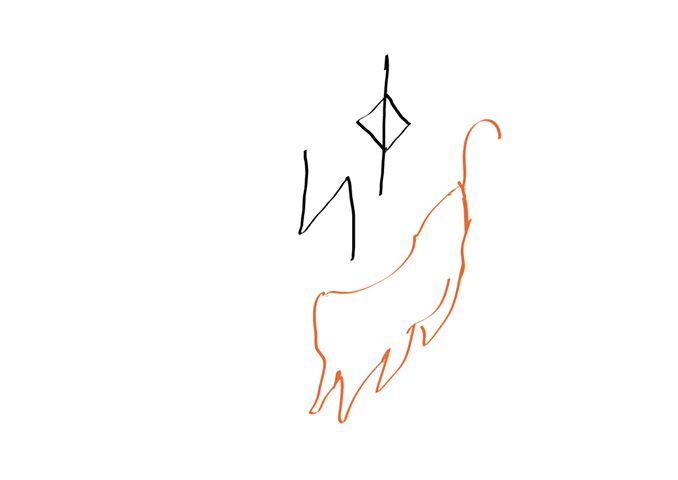
For a while we settled on Rune Beard. We wondered if Nordic facial hair would evoke a space pirate captain firing plasma bolts at sword-wielding mechs on distant asteroids (it was the Warhammer 40,000 side of us that connected runes with sci-fi in the first place), but instead our test audience pictured a neckbeard playing WoW, and incidentally, they weren’t wrong. Dumping Rune Beard was emotional for me, because Alyssa, Stuart, and I had devised an awesome icon to accompany our logo—a bewhiskered Odinesque whose face was comprised of two Anglo-Saxon runes that corresponded with our initials (the scarred-eye is the jera, or j-rune, and my first name is Jared; the crooked nose is the sigel, or s-rune, i.e. Stuart). Being boys, we didn’t consider adding a rune for Alyssa.

Here’s Alyssa’s mock-up:

However, while I was pining over Rune Beard in my notebook, I noticed that without the “D” there was another great name for our mag—Rune Bear. The domain wasn’t taken, and there weren’t any rune bears out there except for the Runeclaw Bear in Magic the Gathering. The others were hesitant but the name grew on them. I went ahead and drew a rough sketch of what I was envisioning for the mascot. (Although these details weren’t in the sketch, I knew the bear had to be blue and have a rune in its mouth).

I finally turned to an old friend of mine, Phil Kiner, to create the mascot we have today:

Writing Process

Filler

We needed filler content for a literary magazine we’re creating, i.e. stuff of no consequence that will be deleted once we publish. So I wrote this.

“The Robot” by Botswana Brokeball

There is a girl who is a robot. She wakes up in the wastelands but doesn’t remember who she is (actually she’s a secret human). All the humans are dead but she doesn’t know until she meets communists called the Rainbow Riders. Their symbol is the rainbow. In my story all robots are rainbow stripe colors. The girl-robot-secret-human is named Eve, the first human. She’s actually the first human cryogenically frozen by Adam to be awakened when the technology has developed to de-freeze cryogenically frozen women. Eve decides to rename herself Even Stevens. After a lot of walking in the dust-broke wastes, her CPU glitches, and her hard drive crashes, and her URL is hacked. She was a robot the whole time! The story ends with a vulture digging a nest into her brain and finding pink gummy brains to its delight and surprise. She was a human the whole time too! In the end I show up in the book to congratulate the reader on finding the secret, then I tip my fedora and walk off the page. I was the monster at the end of the book!

Author Bio

I am from Remdonesia which is a small independent nation-state in the offshore drilling waters of California, America. Don’t be alarmed if I send you intimate details about my body via Facebook. I am only testing the ability of humans to communicate over long distances via Facebook. Shout out to nail clippers. Y’all the real heroes.

Writing Process

Writ in Water Updates

Last year I launched a student magazine, Writ in Water, through HBU’s Academic Success Center. At the time I was the center’s Writing Coordinator, a position that involved working with staff and tutors to assist students with academic writing. That was, after all, the mission of the ASC—”to facilitate student academic success.” But I also wanted to promote student success through creative writing. All throughout Fall and Winter, I worked diligently with my Assistant Director, Samantha Bottoms, and a dedicated corps of tutors to set up a submission and reading period and finally a physical print of the magazine.

After I graduated from Houston Baptist University, I stepped down from my role as the Writing Coordinator and redevoted my full attention to my career as a high school teacher. Call it a year of rest where I no longer had to be a teacher by day, student by night, and writing coordinator in-between. Along with my ASC retirement, I passed on Writ in Water, a campus literary magazine that I founded, to an amazing dude named Seth Grant.

This semester I’ve been sneaking into a Roman History course (all right, fine, I’m not that cool—the professor lets me swing by), and just imagine my profound sense of place when I discovered that HBU will be continuing the Writ in Water series!


I’m excited.

Writing Process

Author Interview at Theme of Absence

Theme of Absence runs an author interview series alongside its original fiction called, well, Theme of Absence Author Interviews. These dialogues employ the same questions every week, allowing readers to scan questions and spend more time on author replies. If you want a mixture of pragmatic and wild writing advice, I recommend a chai tea with a pinch of milk (I guess I’m not sure how milk works?), a comfy chair or lap, and one hour spent (c’mon, don’t be cheap) in the magazine’s archive (located here).

Oh, and don’t forget to read my interview for “The Spheres.”

Writing Process

CONTENT

My Table of Contents mock-up for Writ in Water with fictional authors and titles. I’m excited to report my Editorial Board has reached the point where I can fill these slots with actual submissions, but I’m sad I have to lose these placeholders.

Life, Writing Process

First post about Writ in Water

This past week I opened the submission period for Houston Baptist University’s debut literary journal Writ in Water. The submission period started on the 8th of November (i.e. on the same day as the US Presidential Election), will conclude on the 8th of February, 2017, and the journal will be published digitally on May 1st. Writ will be accepting short stories and poetry, and although the publication is affiliated with a Christian college, the submissions will not have to be religious in nature. Instead, Writ’s editorial board is seeking literature that combines good writing and the human experience.

Writ is the result of months of deliberate planning and meetings, but I have wanted to start a literary journal for a long time – since childhood, in fact, when I first read an issue of The New Yorker and wondered about the lives of editors-in-chief. When I began working as the Writing Coordinator of HBU’s Academic Success Center, I realized that my life goal could also benefit the college community, especially its emerging writers and artists. The Success Center, after all, doesn’t only serve struggling students with their grades – success comes in a variety of forms, including publication.

The Academic Success Center and HBU Administration were very supportive of the journal. My conflict was naming the thing. Trouvaille, which is French for a lucky find or discovery by chance, was considered, along with Numinous, a word that means a strong spiritual moment or the presence of divinity. But Writ in Water had three aspects which won out in the end:

Aspect One) On Mount Sinai, as recounted in the book of Exodus, Moses received two tablets of covenant law. These Laws were God-writ and therefore eternal. From this we have derived the idiom “nothing is written in stone” to signify that nothing else is permanent, perpetual, or predictable.

Aspect Two) The phrase “writ in water” comes from John Keats’ deathbed request to not include his name on his gravestone. Instead, the young feverish poet who “foresaw his death with brutal clarity” wanted only the mysterious line: “Here lies One Whose Name was Writ in Water.”

Aspect Three) The Bible, too, has a context for water, as God’s Word, as God’s Intervention, as the Holy Spirit. Isaiah 44:3 says that God will “pour out water on the thirsty lands and streams;” Corinthians 12:13 that “we were all baptized into one body… we were all made to drink of one Spirit;” and Jesus says in John 3:5 that “no one can enter the kingdom of God unless they are born of water and the Spirit.” Appropriate metaphors for a Baptist institution.

From these wells I draw my inspiration.

Reference

Stacey, Michelle. “Writ in Water: The enduring mystery of Keats’s last words.” The Paris Review, 23 February 2016.