Writing

Nonfiction — “New Territory for Old Slavery”

In 2019, New Territory is concentric circles of green grass cloistered by brick houses, brick walls, brick veins. The streets have pretty names like Whisper Ridge and Rippling Creek and Silver Lake, imagining a lost era of folkishness, only this is the knees of Houston and there never was whispering, rippling, or silver anything, only marshland turned to farmland turned to homeland.

The suburb wears a coat of trees which make the residents hostile when the government cuts them down, arguing that the trees have history, roots, are more than shadow-makers, but no one mentions that they were planted, full-grown, in the late nineties alongside the people. A militia of invisible gardeners marches through the parks, and when the trees are bare-limbed, none can tell if the leaves were individually picked or if it’s Late Winter.

An aerial photo in George Memorial Library shows a different New Territory.

Continue reading

Writing

Nonfiction — “Teaching Tapas”

(One)

My classroom is a block like those you stack in first-grade. Desks stand like lines of British soldiers, and students shout and throw rulers and text each other in a war of attention. My desk is the general’s tent—to the side of the parade grounds and barracks, capable at a moment’s notice to survey the ranks (all I have to do is lift my eyes from my screen to review a regiment using phones to redo eyelashes).

From this distance, it’s difficult to tell if a student is passing notes digitally or using a calculator to complete physics problems. With a war weary sigh, sans mustache, cigar, and epaulets, I rise from my command to remind the infantry that the assignment is due in five minutes.

(Two)

Sometimes I’ll see a student staring out the window at the end of the hall. But what does she see out there that holds her attention? I know from experience there’s only a gray lot, cars, the track field, the tennis court—all yellow and hazy behind the dusty glass.

But I don’t think she’s looking at anything in particular.

Maybe it’s a mood she senses on the other side of the pane. Across the gold beer plains, coming from distant mountains.

A feeling she won’t find among white walls that slide into a maze of locked rooms and lockers. Halls guarded by ceiling cameras and attentive teachers.

Out there? Streets and side-streets. The brown roofs of suburbia. Highways weaving with the hills like little gray veins. And patches of trees binding shadow-flooded plains to the homes of coyotes.

Sometimes I know what she sees.

Writing

Uncategorized Short Prose

“Not having anything to do, or to stave off the heart attack forming in my chest (it turned out to be gas), or to hold off a walk to the gas station for cigarettes, or to creep away from the wife awhile, ornery ever since she noticed a carpet growing on her chin (it happens at this age), I turned on the light in the garage.”

Read more of “Seven Days.”


“Look at the sympathy and bravery of the Wheelbarrow Queen. Look at the tattoos of endless scrolls that unfurl down her arms. These signs carry murderers and lovers, boring summers and drunken falls.”

Read more of “The Wheelbarrow Queen.”


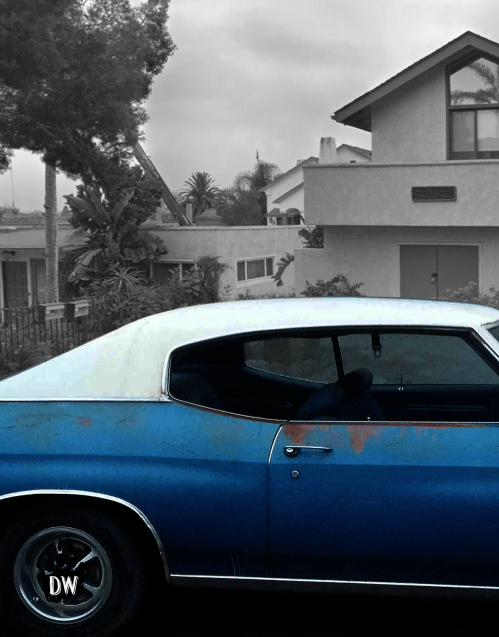
“I will never forget it. Blue as the Kelley Blue Book, a proud white belt, dual headlights like plates on display and squinting taillights.”

Read more of “That Chevy Impala.”


“Leagues ahead, as if justification for the old man’s suffering, was a boat. How could refuge exist out here in the abandon? The red dust and crags. Would he find whale bone, and coral, and mermaid skulls, and impossible Lemuria?”

Read more of “Above the Snakes.”


“Their hands are spiders on my scarf when I’m not looking. They pull the cornice in the back until my forehead is uncovered and I notice and hiss. They untie the knot by my right breast or pinch the cloth, leaving wrinkles.”

Read more of “Saamiya.”

Scifi

Fiction — “A Zelzer Stiff”

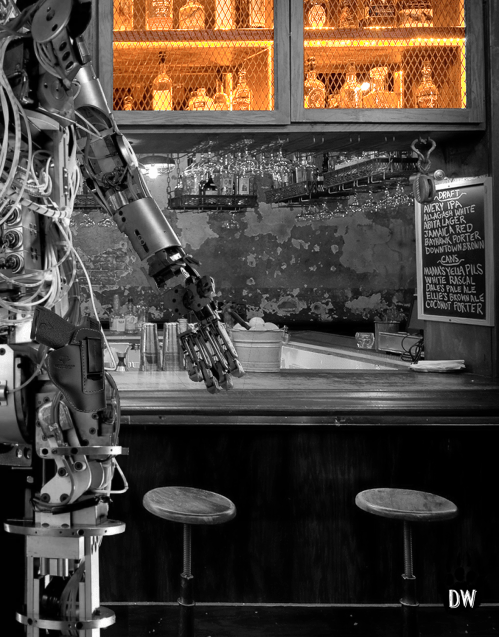
The android was making them all uncomfortable with its Zelzer Stiff eyeing them from its hip. It’d only been forty point three seconds since the landmark decision to include artificial humans in the Second Amendment and this son of a manufacturing plant had just walked into the Rig & Rattle with a laspistol holstered, twinkling. Kghoshi—a real bastard on a good day—splashed his drink on silver chestmetal and said, “You packing, tin can?” The bartender—a saint on a bad day—put an arm on the droid: “C’mon, now, let’s not do this.” The move was registered as an offensive action and the android shot the bartender between his eyebrows. Kghoshi’s finger moved a centimeter toward his gun when a second shot put a red dot on his forehead as uniform as urna. The men in the bar leaped to their feet. Offensive actions. The men in the bar toppled over chairs and tables. By the time the android reached the counter, empty now of breathing souls, a feed of reaction times, facial registers, psycho-prints—all pointing to self-defense—had been submitted to local authorities.

Published at Rune Bear Weekly on December 6th, 2018. 

Life, Scifi, Writing (Published)

Published in Texas’s Emerging Writers

Half-a-year ago, I was contacted by Z Publishing about contributing to their “Emerging Writers” series. Having launched a successful run of “Emerging Poets,” the publishing house was seeking to publish new writers from every state in what they called a “sampler platter.”

I was ecstatic. I penned a flurry of fiction and plagued critique groups for several months. There were no specifications on genre, so my pieces were strange and speculative. One was about monks hunting a bear in an underworld library and another was about a man buying terraforming equipment.

Z selected “House Divided” from my slush of submissions. The story is about a recent divorcee ruminating on her home, which, instead of being given to her or her ex-husband, has been split interdimensionally between them. In essence, her husband has become her ghost, a reminder of a life lost to the vibrations and footsteps emitting from her walls.

texas emerging authorsSo here we are—with my plug. There are two anthologies from Texas. Mine’s the tree behind bluebonnet, a hazy sun on the horizon, pink-gray clouds smearing the sky. I’d be honored if you purchased a copy.

Fantasy, Life, Writing (Published)

Published — “Like Flies, Like Lights”

This isn’t my publication, but my wife’s. “Life Flies, Like Lights,” which published in Nowhere.Ink, is a dreamy spelunk into a maze of madness or what might be the halls of the dead. I have no idea, actually, but it’s still freaky, especially the line “All around me are sounds like suppressed laughter in mausoleums, like bouts of applause, like flies on a cat corpse in summer.”

Anyway, I’m so proud of J. Motoki and the products of her horrifying brain.

Nowhere.Ink is a digital collaborative devoted to dark minds and cooperation over competition. Its members have several outlets. Polished pieces go in their Library (like my wife’s) while anyone can post prose or poetry to the Facebook page. Then there’s other worlds like Twitter and their Red Light District.

Actually, my wife and I have a little history with the collab. We, along with its creators, used to post to a literature platform called Prose.

That site went south, forgetting its manners and indulging in toxic utilitarianism. Lost were Partners and $100 weekly contests; found were advertisements, random rules, and Prose Gold, a pay-to-be-a-partner subscription service. Suddenly good writing wasn’t based on its popularity but how much you could pay.

There was also a (now-infamous) Simon and Schuster challenge where fifty stories were picked from 500+ entries and submitted to S&S for review. Some of the entries “selected” were written by the Prose judges themselves, a little bit of unethical behavior that did not go unnoticed. (My piece, Iron Abbie, was also chosen, and I add that only to establish that I’m not bitter for losing.)

The first generation who’d given Prose its style split away. Luckily, Tony Cavanagh and Amanda Cary, two brilliant contributors to Prose, gave some direction to the Great Migration. They created an alternate platform, a place devoted to the exercise and excitement of writing. Funny enough, the “nowhere” in Nowhere.Ink comes from Tony’s old Prose handle—Miles Nowhere.
Scifi

Short Prose (Science Fiction Friction)

“The android was making them all uncomfortable with its Zelzer Stiff eyeing them from its hip.”

Read more of “A Zelzer Stiff.”


“Between two trees exploded into boulder stumps, Elemmírë raised a fist. Behind him, ten figures, barely visible above the gloom and bloom, dropped to their knees and scanned the street.”

Read more of “Garden War.”


“There’s always that one friend who sticks to the group like a discount sticker on a used book…”

Read more of “The Immortality Cube”

Fantasy, Life, Scifi, Writing (Published)

Published — “And We Who Never Died” & “Scarabaeidae”

My pieces “And We Who Never Died” and “Scarabaeidae” were published in the Spring Issue of The Tishman Review, a well-respected quarterly magazine devoted to prose, poetry, and people. Behind the paper’s philosophy is the idea that literature’s “value to humanity is beyond measure.” Editors must “remain open to the possibility that an individual work may take us beyond the boundaries known today.”

“And We Who Never Died” began as a metaphysical conflict. What if when we die, our souls don’t abide the afterlife, or face annihilation, but transfer to the objects around us? What horrors would arise? What fears? The story—about a mother sending her children to search the house for their dead father—is one of many scenarios that might result.

“Scarabaeidae” is an ode to my wife, to us. I try to write without goo, mush, doggerel, singsong, cockamamie, and all those wonderful descriptors of poor poetry. But then, “Scarabaeidae” does have a line that begins with “shall I compare thee to.” Maybe it works since it ends in “a dung beetle.” Glimpsed here is the failure and mundanity of the struggle to love another.

You can pick up a copy of The Tishman Review from their website or order it from the source on Amazon.