Life, Scifi, Writing (Published)

Published — “Two Wings Flightless”

Kasma Magazine published my science-fiction short, “Two Wings, Flightless,” about a man who has to destroy a hovership that’s been solar-beaming the countryside. Kasma is a speculative magazine that publishes a story every first day of the month. Each piece is accompanied by a beautiful bit of art by Jose Baetas. You can see his treatment for my story above.

In “Two Wings,” I wanted to replicate the hero goes to a cave to slay a dragon story in a post-apocalyptic setting, switching the fire-breather for a flying war machine. The result was really fun to write, especially since the narrator was so dour and grit-happy. I’m already planning a sequel.

Life, Scifi, Writing (Published)

Published — “Good Fulch”

Good Fulch” is a story I’ve had in my head since high school. The premise is this. A society of robots have to decide if they should let a human live. The original draft was more human-focused; Charlton Heston shaking his fist at those “damn dirty CPUs.” But on a whim I switched the POV to the metal-heads themselves: glorious, dirty, regal, logical minds falling back on the xenophobia that once infected their creators.

The piece’s publication is Ripples in Space, a seasonal magazine devoted to “all things Sci-Fi, Dystopian, AI, [and] Space Marine.” It was the Space Marine mention that intrigued me, being an advocate for both Warhammer 40,000 and the works of Robert Heinlein.

“Good Fulch” features in this year’s Fall Selection.

Fantasy, Life, Writing (Published)

Published — “Directions After Death”

This isn’t my achievement, but my wife’s. Coffin Bell has published J. Motoki’s “Directions After Death” digitally and physically in their first print issue. If anyone’s interested, the anthology, Coffin Bell: ONE, is available for preorder ($15). Per usual, I’m both horrified and impressed by my wife’s dark literature. Where I’m satirical and speculative, she’s weird and wonderful and clearly, clearly, the better writer.

Life, Writing (Published)

Published — “Cuidado”

Forgot to mention this when it came out. Life gets busy sometimes. One of my poems published at the end of August.

Rue Scribe is a magazine devoted to “Small Literature”—to “micro fiction, flash fiction, tiny fiction,” and to, eh, what the hell, “short shorts.” This cigarette drag of story is about the “small but powerful,” about the smoke that lingers. That’s why I’m honored RS chose to publish “Cuidado,” a poem condemning global violence on women through a life-changing encounter that lasts no more than five seconds.

Life, Scifi, Writing (Published)

Published in Texas’s Emerging Writers

Half-a-year ago, I was contacted by Z Publishing about contributing to their “Emerging Writers” series. Having launched a successful run of “Emerging Poets,” the publishing house was seeking to publish new writers from every state in what they called a “sampler platter.”

I was ecstatic. I penned a flurry of fiction and plagued critique groups for several months. There were no specifications on genre, so my pieces were strange and speculative. One was about monks hunting a bear in an underworld library and another was about a man buying terraforming equipment.

Z selected “House Divided” from my slush of submissions. The story is about a recent divorcee ruminating on her home, which, instead of being given to her or her ex-husband, has been split interdimensionally between them. In essence, her husband has become her ghost, a reminder of a life lost to the vibrations and footsteps emitting from her walls.

texas emerging authorsSo here we are—with my plug. There are two anthologies from Texas. Mine’s the tree behind bluebonnet, a hazy sun on the horizon, pink-gray clouds smearing the sky. I’d be honored if you purchased a copy.

Life, Writing (Published)

Published — “Boar Song”

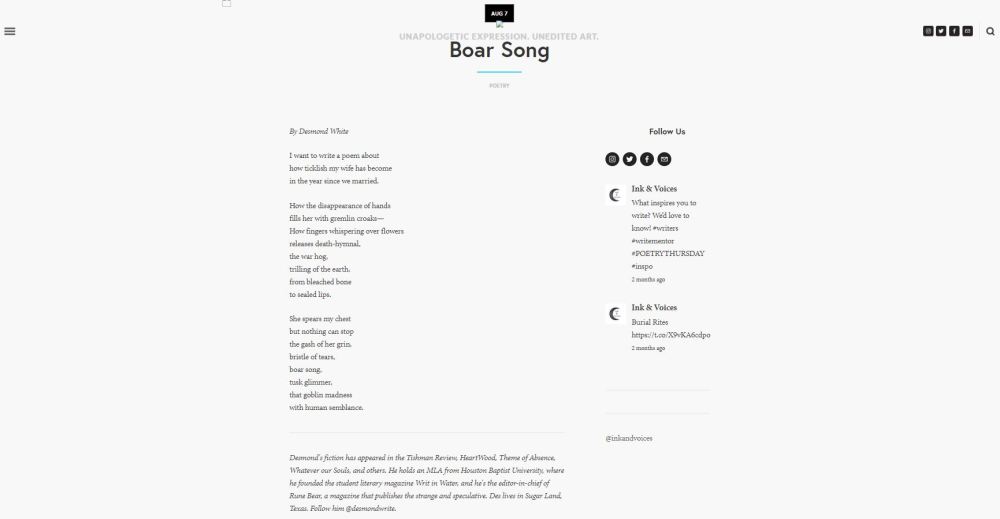
My poem, “Boar Song” published in Ink & Voices, an online publication devoted to “unapologetic expression, unedited art.” The magazine seeks to provide a space for “humanness” and has a predilection for the “honest, raw, and original.” Meanwhile, my poem, about my wife who turns goblinesque when I tickle her, was an attempt to express my adoration without praise-filled language.

I couldn’t have found a better venue.

EDIT: Or could I? As of 2019, the website seems to have disappeared. Ah, the fickleness of internet-based publications. The editors sent me a screenshot, however, as some form of compensation. Here it is. Proof that this piece was published once.

Fantasy, Life, Writing (Published)

Published — “Like Flies, Like Lights”

This isn’t my publication, but my wife’s. “Life Flies, Like Lights,” which published in Nowhere.Ink, is a dreamy spelunk into a maze of madness or what might be the halls of the dead. I have no idea, actually, but it’s still freaky, especially the line “All around me are sounds like suppressed laughter in mausoleums, like bouts of applause, like flies on a cat corpse in summer.”

Anyway, I’m so proud of J. Motoki and the products of her horrifying brain.

Nowhere.Ink is a digital collaborative devoted to dark minds and cooperation over competition. Its members have several outlets. Polished pieces go in their Library (like my wife’s) while anyone can post prose or poetry to the Facebook page. Then there’s other worlds like Twitter and their Red Light District.

Actually, my wife and I have a little history with the collab. We, along with its creators, used to post to a literature platform called Prose.

That site went south, forgetting its manners and indulging in toxic utilitarianism. Lost were Partners and $100 weekly contests; found were advertisements, random rules, and Prose Gold, a pay-to-be-a-partner subscription service. Suddenly good writing wasn’t based on its popularity but how much you could pay.

There was also a (now-infamous) Simon and Schuster challenge where fifty stories were picked from 500+ entries and submitted to S&S for review. Some of the entries “selected” were written by the Prose judges themselves, a little bit of unethical behavior that did not go unnoticed. (My piece, Iron Abbie, was also chosen, and I add that only to establish that I’m not bitter for losing.)

The first generation who’d given Prose its style split away. Luckily, Tony Cavanagh and Amanda Cary, two brilliant contributors to Prose, gave some direction to the Great Migration. They created an alternate platform, a place devoted to the exercise and excitement of writing. Funny enough, the “nowhere” in Nowhere.Ink comes from Tony’s old Prose handle—Miles Nowhere.

Fantasy, Life, Scifi, Writing (Published)

Published — “And We Who Never Died” & “Scarabaeidae”

My pieces “And We Who Never Died” and “Scarabaeidae” were published in the Spring Issue of The Tishman Review, a well-respected quarterly magazine devoted to prose, poetry, and people. Behind the paper’s philosophy is the idea that literature’s “value to humanity is beyond measure.” Editors must “remain open to the possibility that an individual work may take us beyond the boundaries known today.”

“And We Who Never Died” began as a metaphysical conflict. What if when we die, our souls don’t abide the afterlife, or face annihilation, but transfer to the objects around us? What horrors would arise? What fears? The story—about a mother sending her children to search the house for their dead father—is one of many scenarios that might result.

“Scarabaeidae” is an ode to my wife, to us. I try to write without goo, mush, doggerel, singsong, cockamamie, and all those wonderful descriptors of poor poetry. But then, “Scarabaeidae” does have a line that begins with “shall I compare thee to.” Maybe it works since it ends in “a dung beetle.” Glimpsed here is the failure and mundanity of the struggle to love another.

You can pick up a copy of The Tishman Review from their website or order it from the source on Amazon.