Life, Scifi, Writing Process

Failed — A Webcomic called Mudball

As a summer cleanse, I’m detailing some of my failed projects over the years. (Believe me, there are a lot of them.) One of these failures was GLADiatorsa webcomic about goofballs locked in deadly combat. This week, I will focus on a spin-off.

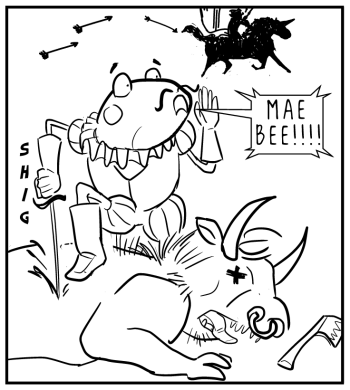
Having dropped Gladiators, Phil and I decided to create a shorter, more focused fairy tale that took cues from sci-fi and Peter Pan. We cut the Cloudiseum, dropped Roland and Coolio and our wacky cast of sword-whackers and whack-jobs, and tossed out the Battle Royale for something simpler but no less sinister.

Instead, the focus would be the conflict between two planets, and really, two ideologies.

We called the series Mudball.

In this cosmos, there was a planet called The City made up of freeways and skyscrapers. Only grown-ups lived in The City, where suits and ties were mandatory, and everyone possessed a white-collar, corporate job. The form of government was Bureaucratic Monarchy. Due to a string of filing mishaps, there was no king, just a council paralyzed by paperwork and parliamentary procedures no one could recall.

The City had a counter-planet (really a moon) called Mudball, a marsh world full of children. This is where the adults of The City grew up (literally from pea pods). On Mudball, the children grew wild and free, playing imaginative games and exploring. All of this was secretly (and actively) monitored by machines disguised as animals and plants.

Every winter, harvesting machines picked the oldest kids to become adults. The children were brought to The City, given suits, given jobs, and spent the rest of their lives in the unhappy humdrum of cubicles and cafeterias.

In-story, Maebee, our protagonist, has just turned 12 (the proper age for collection) but doesn’t want to leave her friends or freedom.
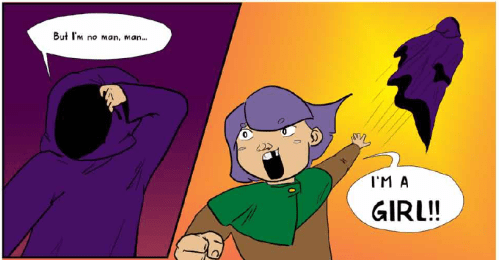
Maebee decides to trek across Mudball in search of some place to hide. This is her ‘Call to Adventure’—to seek an alternative to adulthood.

Her adventures lead to an adult living in the swamp, a stubbled, dirty-suit-wearing man named Patricks, who has never grown up, but lives a slouchy, unhappy life in a stolen reaper. Think Peter B. Parker from Spider-Man: Into the Spiderverse.

The story would continue to The City, where Maebs joins a resistance group called The Jobless (blame this on the writer’s anti-establishment attitude), and seeks independence for Mudball.

The webcomic would have explored the conflict between our biological compulsion to grow up versus the unnatural but hegemonic cultural expectations of what that actually means.

However, like GLADiators, the project didn’t make it past a few pages, partially due to the influence of a mutual friend who advocated against our project without really understanding it, calling our scripts amateur and pointless.

Later I would discover that he was trying to convince Phil to work on his project—a Dune-like comic where one’s reputation is both a physical and psychic currency. Phil would go on to assist this friend for a while, but quit when the man turned out to be a frustrating micro-manager.

It didn’t help that I was seriously depressed at the time, living in a small town without nearby friends, working as a tutor and substitute while pursuing my teaching certification. Even my girlfriend (now wife) was three hours away. I put up little resistance when the project ended, taking my friend’s criticisms for truth. It wouldn’t be until 2016, two years later, that I would shake off self-pity, smack my inner demons, and begin writing again.

Today, I keep a wary vigilance of friends with ill intentions, although I’ve forgiven this particular intruder for his self-concern. There is a lust for celebrity that consumes people and hurts their ability to rationalize or promote the dignity of others. I understand that, and try not to fall prey to it myself.

And when it comes to Mudball, I hope to revisit this project someday as a short story or novel.

I guess what I’ve learned is this. Don’t fall with your failure. Just steal from the ruins.

All of this post’s art (except for my crayon drawing of Patricks) was created by Phil Kiner.
Life, Scifi, Writing Process

Failed — GLADiators Webcomic

Long before PUBG, Fortnite, H1Z1, Apex Legends, and the resurgence of standalone survival games, Phil Kiner and I were planning a webcomic called GLADiators.

Inspired by Harvey Birdman, the series would be a cartoon pastiche, using intensely different art styles in juxtaposition. Inspired by Koushun Takami’s Battle Royale, the series would depict involuntary warfare between strangers on a coliseum-like island.

Our premise was this:

An extra-dimensional race called the Administrators has picked champions from every dimension in the Multiverse and placed them on a floating island called the Cloudiseum.

Only one champion would be allowed to leave—the final survivor of a long, bloody war of all against all.

Our protagonist would be a rough-and-tumble girl named Maebee (pronounced “Maybe”) from a kids-only dimension (think Neverland).

Maebee would be Tom Sawyer and Huck Finn incarnate—reckless, deceptive, fun, not taking things seriously until forced by circumstance or conscience. She would also be an anomaly—the only child, and therefore (seemingly) easy-pickings.

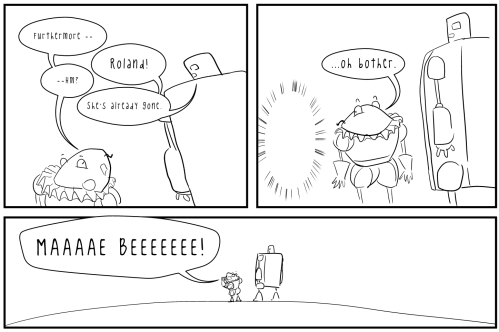
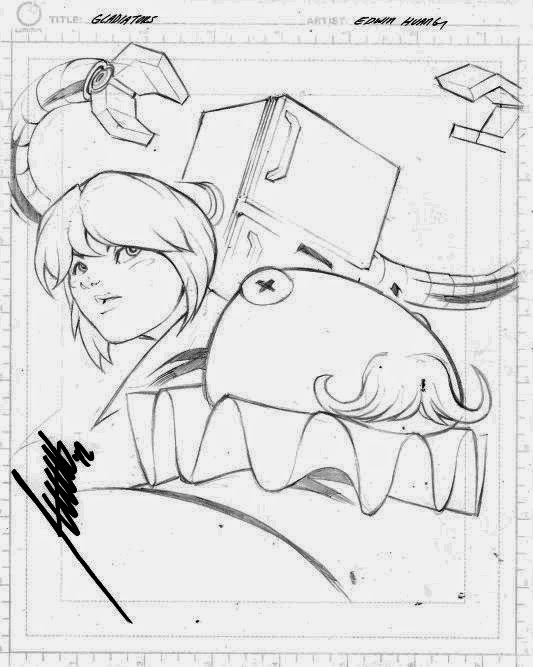
One of her companions was Roland, a talking frog with a rapier, a courtly mustacheteer with pomp, decorum, and bravado.

We envisioned Roland as a cross between C-3PO (in his anxious concern for Maebs) and Inigo Montoya. Roland, a toad of honor, could not bring himself to kill a child, even in raw combat, and even saw her as his ward to protect.

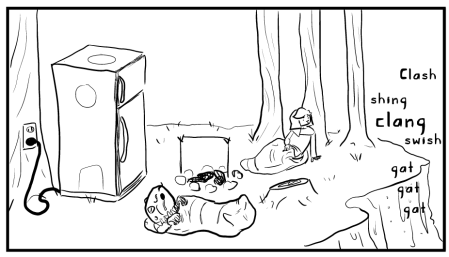
Her other ally would be Coolio, a refrigerator with ice magic.

Coolio hailed from a dimension of talking appliances, a world where Game of Thrones meets Ikea, what you might call swords-and-smoke-detectors.

Coolio made his peace with fate, choosing to live harmoniously in the Cloudiseum instead of as a brutal pawn. He’d only kill reluctantly and in self-defense. In other words, Coolio was a chill dude.

We also created a ridiculous cast of GLADiators, including a Mormon with Eagle Powers, a sleazy Jiminy Cricket running a criminal empire, a hare who rides a tortoise and wields a carrot spear, a prison wasp with black and white stripes, the Segturion (a Roman Centurion on a segway), an expy of He-Man in a wheelchair, and Mecha Kurt Cobain. There was a guy in a speedo who kept rubbing his nips. A Veigar-sized Boba Fett. And the Butt Punisher, a Frank Castle type who forcibly spanks the Mafia.

The series would have followed Maebee, Roland, and Coolio as they survived harrowing attacks, became minor celebrities in the Multiverse, and led the resistance against the very regime trying to pit them against each other.

As a writer, I had a lot of fun developing the Behind-the-Scenes, a sequence of utility corridors and panopticons where the Admins control the island. And crafting the ending, where Maebee, secretly afraid of becoming a boring adult, grows into a clever, exciting, and wonderful woman (who wears a suit and tie and carries an enormous axe).

But the series was not meant to be.

Phil was pursuing a career in graphic design; he became bogged down in projects. I was pursuing my own profession in education—a turbulent project in itself, and very time-consuming.

We decided to abandon what was appearing to be a long, long enterprise, but we still retain those happy memories of collaboration and creativity.

All of this post’s art was created by Phil Kiner.

Life, Writing Process

Brandon Sanderson — Writing Things

I went to see Brandon Sanderson at the Tattered Cover in Denver.

You know, the guy who finished the Wheel of Time series and wrote Mistborn and forty-four other novels. He’s sort of the James Patterson of fantasy literature except Brandon actually writes his books and has a powerful, simple prose (as opposed to just simple). Maybe Stephen King would be a better comparison?

Brandon focused his lecture on failure and the difficulty of transferring nebulous ideas into physical writing. Although he was here to sell Skyward, the nucleus of the night was how his failed attempt at a novel in 2002 became Way of Kings.

A few of his best bits (paraphrased o’ course):

  • “You create beautiful stories in your head. Then sit down and what comes out is awful and dreary and miserable and flawed. You don’t know what to do, and feel dumb because you’ve been learning how to write since Kindergarten. You worry that you’re screwing up something wonderful.”
  • “I’m here to tell you there’s creation in destruction. And good stories from patience.”
  • “Sometimes you need to write the imperfect story. Reach into the stars and reveal their ugly flaws. You won’t get the story you’re searching for. But someday later, you’ll reach back, and give your brain something to fix.”
  • “The more you write, the more you identify plot archetypes, and separate archetypes from trappings. I’m not dismissing other writers, just different directions. Only when I’m stumped do I go to others. Otherwise, I use my instincts and systems. Going from premise to outline to drafting. Keeping that careful balance between determination and discovery.”


Life, Writing Process

Markus Zusak — Writing Things

I went to see Markus Zusak (of Book Thief fame) read from his latest novel, Bridge of Clay.

Zusak wore a cream sweater and thin black pants—a mix of charm and casual. He had a surprising Australian monotone with which he delivered an arras of anecdotes and advice. From a story about his life (basically, Zusak manipulated his brother to crack an egg on his forehead), he drew five key points:

  1. “Stories from your life are the easiest place to start.”
  2. “There were two levels to my story. On the top—the switching of the egg. Underneath was the backstory. About hating my brother. About my Dad’s gruff exterior. Know what happened to the characters before they show up.”
  3. “I include small details like sitting on paint cans and the crack of the egg not because I can picture it, but because as a writer I can do simple things well, so people will believe.”
  4. “The best moment was supposed to be my brother smacking himself with an egg. But the best reaction was when my Dad said, ‘Brilliant.’ The unexpected is what helps story.
  5. “I’ve told this story a thousand times. It’s been work-shopped.”

After reading a portion of his new novel, Zusak went to interview questions. I’ve collected the best of his answers:

  • “It’s often the little things in books that are true.”
  • “Writing is a mountain with a sandpit at the top and if you can get there you can play.”
  • “Coffee is good.”
  • “Don’t network or latch onto other writers or form a club. The key attribute to writing is you need to be sitting alone. A lot.”
  • “It’s not about being better or worse than others. Write books only you can write.”
  • “More often than not the author did intend the meaning. I put it there for a reason. But also the more depth you put in, the more there is to find. The connections and relations.”

And my favorite bit:

  • “Absolutely no one encouraged me to be a writer. My teachers didn’t think I could write. Parents didn’t know. I just knew what I wanted, that I was most alive when I was reading or writing. I never won a contest, never published. I bet everything on my book, and endured eight years of rejections. You don’t have to be encouraged. No one has to believe in you. You can do it, you just have to really, really want it.”

Life, Writing Process

Kathleen Glasgow, Library Luminary

Kathleen Glasgow (of Girl in Pieces fame) swung by my school to speak about the dark places she’s been and the dark things she’s written.

Glasgow wore a black coat, a shirt reminiscent of prison bars, thick glasses, the kind writers wear. I felt bad for her. The air was insufferable. This time of year, Colorado has a pattern of snow days, but today the sun was out, the streets glaring, and the school hadn’t lowered the thermostat.

When she started, I thought she was about to ask if anyone had read Girl in Pieces. Instead, Glasgow asked, “Have you ever lost someone?”

So many students put up their hands.

“Do you know someone who self harms?”

More hands.

From there, her lecture sought to answer the question: What do you do with pain? With darkness? With feelings that hurt?

As you may not know, I’m a high school teacher, so I had to smile at my colleagues’ faces when Glasgow spoke about low grades, perpetual truancy, her expulsion and GED, drugs, alcohol, an early career at Wienerschnitzel and Jack-in-the-Box. And when she muttered “shit” into the microphone. Not exactly the narrative we impress on students.

Now, while she may not be a model of academia, to the nation of women falling and failing and hiding scars under long sleeves, Kathleen Glasgow is an avatar of hope—a sign that art and literature and the wondrous act of creation can salvage scraps, can save the soul.

But the answer wasn’t only art. It was the act of honesty. Of unwinding and expressing the truth without romance. “I write books for people who think help me help me help me,” Glasgow told us. “But say I’m fine, I’m fine, I’m fine.”

“People tell you—you’ll get over it, you’ll heal. Not true. You go on with the weight of that trauma for the rest of your life. You learn to be with it.”

“If I’m not going to be open about it, who’s going to be open about it?”

Her final piece of advice to the assembled classes, freshmen to senior, was this:

“Do not self-censor. Always believe in the story burning inside you. Write it. Rewrite it. Read as much as you can. Reading assists your sense for story, teaches structure. And never, never be afraid of the things you want to say.”

Life

Assistant Editor at Coffin Bell

Very excited to announce that I am now Assistant Editor of Coffin Bell, a quarterly online journal (they also have an annual print issue) that publishes “waking nightmares, dark CNF, dystopian flash, cursed verse.”

I hope to bring my decade of experience in literary circles, workshops, and critique groups (as well as my undergraduate degree in creative writing) to the operating table and get my hands slick with organ rot. I mean weird fiction.

The magazine wanted a headshot so I sent them this:

That’s me, by the way.

Life, Writing Process

Failed — Desmorious

Every writer has several projects initiated with gusto, abandoned with reluctance. My first was a forty-page novel in middle school—a Lord of the Rings knock-off called The War of the Bowl. In high school, my friend Jon Ying and I devised a western desperadoes-and-dragons webcomic called Dustbound. In college, I wrote rough drafts and buried them in the rough. Even now, as I revise my novel, I fear its future in a back-folder on Dropbox.

Continue reading

Fantasy, Life, Writing (Published)

Published — “Black Bear on White Paper”

Literally Stories published my fantasy story, “Black Bear on White Paper.” The story takes place in a realm I’ve envisioned for some time: a forest world founded on an endless, underground library. Unexplained, and mostly unexplored, the library is attended by a small cabal of librarian-monks. The concept combines Borges’s “The Library of Babel,” Tolkien’s Mines of Moria, and the medieval monastery.

Literally Stories was started in 2014 by a wiggle of writers, including a bloke named Adam West (no, not that one). The magazine not only provides a platform for prose and poetry, but encourages reader feedback and author interaction. There’s even a comments section labeled “Your Thoughts” for criticism of the magazine itself. The hope is to give “each story its moment in the sun.” Naturally, this might provide a healthy tan; for others, a nasty burn.