
Satire

Trailers for future installments of the God is Not Dead franchise

Trailers for the movies I would make if I were in charge of the God’s Not Dead franchise.
Senator Hurpkins walks into his office. He looks unhurried, self-assured. All of his secretaries, even the male ones, are huddled around Janet’s desk. Janet looks at him urgently. “Bill, you got to see this.” Hurpkins takes the document she’s holding and looks at it closely. “No,” he says. “That’s not possible.” Janet explains what he’s seeing because movie audiences don’t read good. “They want to delete God’s name from the Constitution. The Constitution.” (The film takes some liberties.) Hurpkins is visibly upset: “NOT THE FUCKING CONSTITUTION. Not on my watch. NOT ON MY WATCH.”

Quick shots of the Declaration of Independence with black highlighter over “Nature’s God” and coins dropping on a counter which read “In Nothing We Trust.” Elementary students recite the pledge of allegiance, skipping “under God.” Scenes of Senator Hurpkins filibustering in front of Congress with an earnest Mr. Smith Goes to Washington desperation. A narrator voiceover: “When the United States of America decides it wants to erase every mention of God from the country, Senator Hurpkins is the only politician willing to fight back. But at the end of the day, Hurpkins has to ask himself, in WHO does HE trust?” Cue the same shot of coins dropping on the counter. Narrator: “The stakes have never been higher.” A fancy dinner party, people are eating steaks. The pun is unnatural, forced. Narrator, again: “He will have to defend God in front of every enemy imaginable. Democrats. The Liberal Media. Planned Parenthood. And… himself?” Hurpkins, kneeling in the street, holds the dead body of Janet. She’s been hit by a drunk driver. He takes a swig of a bottle of Scotch and shakes his fist at the sky. Onscreen, cue the words: “God’s Not Dead 9.” Narrator: “This holiday break, you’ll have to SEE IT to BELIEVE IT.”

A funeral. A procession of grim-faced men bearing a casket on their shoulders. A circle of mourners as the casket’s lowered into the ground. A shovelful of dirt lands on the lid, now placed in its grave. An onlooking celebrity, maybe Tom Hiddleston, holds an umbrella over a crying widow and says, “I can’t believe he’s gone.” His companion, hopefully John C. Reilly, not because he’s perfect for the part, but because I really like John C. Reilly, he’s just a great guy, he’s funny, plus when you see John C. Reilly in a movie you know that at least it’ll have some excellent comic relief, looks around curiously, “What’s that sound?”

The sediments on the casket are vibrating like at the end of Superman v. Batman. Whatever’s inside is alive and powerful. Cut to black. Onscreen, cue the words: “God’s Not Dead 27.” Tom Hiddleston says the arc words, “He has not abandoned us,” which have a haunting, poetic effect.

Little girls jump-rope. Some teenagers jump into a cherry-red Lamborghini Aventador (careful product placement which should pay for half of the movie). Dads mow their lawns and wave impotently at each other. The mediocre tranquility of the Suburbs. Narrator: “The kids of Sugar Creek don’t know it yet, but something is coming to get them.” An actress in her late twenties who’s playing a freshman in high school wakes up coated in fear-sweat. Sexy fear-sweat. The actress, Jennifer Lawrence or maybe new talent, runs downstairs. “Mom! MOM!” she shouts. Mom grabs her by the shoulders: “What, what is it, my little hushpuppy?” The actress has no time for cute names: “I saw him! I saw him!” “Who?” The girl sobs into Mom’s wool cardigan: “I saw God.” The Mom stares enigmatically into the distance as if struck by old but traumatic memories. “Dear Lord,” she says. “He’s back.”

A montage of scenes with teenagers in the grips of terrible, divine events. A teenaged boy, screaming. There are holes in his hands. A girl being dragged up the wall, her arms splayed, her body forming the shape of a tee. Fresh blood on a wall which reads: “Repent.” Then a celebrity, undoubtedly Nicholas Cage, in fact it can’t be anyone else, it has to be Nicholas Cage, drives down a freeway at high speeds, a pistol in each hand pressed against the steering wheel. Nicholas Cage has a face that means business. Cut to Paul Giamatti in an orange prison suit, speaking to Cage from behind a pane of glass. Giamatti: “He’s coming for them!” Nicholas Cage hangs up a phone and walks away decisively. Giammati keeps shouting: “He’s coming for them all! The Lambs of God! Lambs for the slaughter!” Narrator: “No one knows where it came from, or who it will visit next.” The police dredge a body from the river as a dove lands beside red-and-blue flashing lights and watches menacingly. A teenager opens a drawer, sees a Bible, screams, shuts the drawer. Narrator: “God is Not Dead 59: Die Harder.” We see the actress from before crawling down a hall. The shadow of a robed, bearded man falls over her. A powerful voice, maybe Liam Neeson, maybe Benedict Cumberbatch, says, “You are all my children now!” The trailer cuts to black and dark laughter.

Writing

Fiction — “The Poor Rabbit”

Short, odd fiction.

He came home worried about the broth smell misting through the house. He went straight for the cage to find it empty. Did she do it? Did she cook the rabbit?

He sat at the table, disheartened, and when she brought a bowl of soup—just water and meat chunk—he felt an internal brokenness, a crack in that childish hopefulness that had helped him survive poverty for so many years.

The rabbit, the little innocent, sacrificed like everything else.

But when the rabbit hopped out from under the table, he sighed, relieved, and pet it gently.

“Eat,” said his wife, happily. She gestured to his bowl, but where her hand should be was a stump wrapped in bandages.

“Eat,” said his wife. “Eat.”

Life

Define Man in Two Words

An exercise from my work as a teacher.

That’s the challenge I posed to my Humanities course. I made it clear that I was using the gender-neutral variety of “man” (meaning I wouldn’t accept a “cheating pig”), that I wanted to avoid unrewarding labels like “Homo sapien” and “human being,” and that I preferred an adjective paired to a noun, or a genus and specific difference.

Think, I said over confused glances. What makes man different from every other living and non-living thing?

Their answers were wonderful.

Continue reading

Life

Desmond Write has style

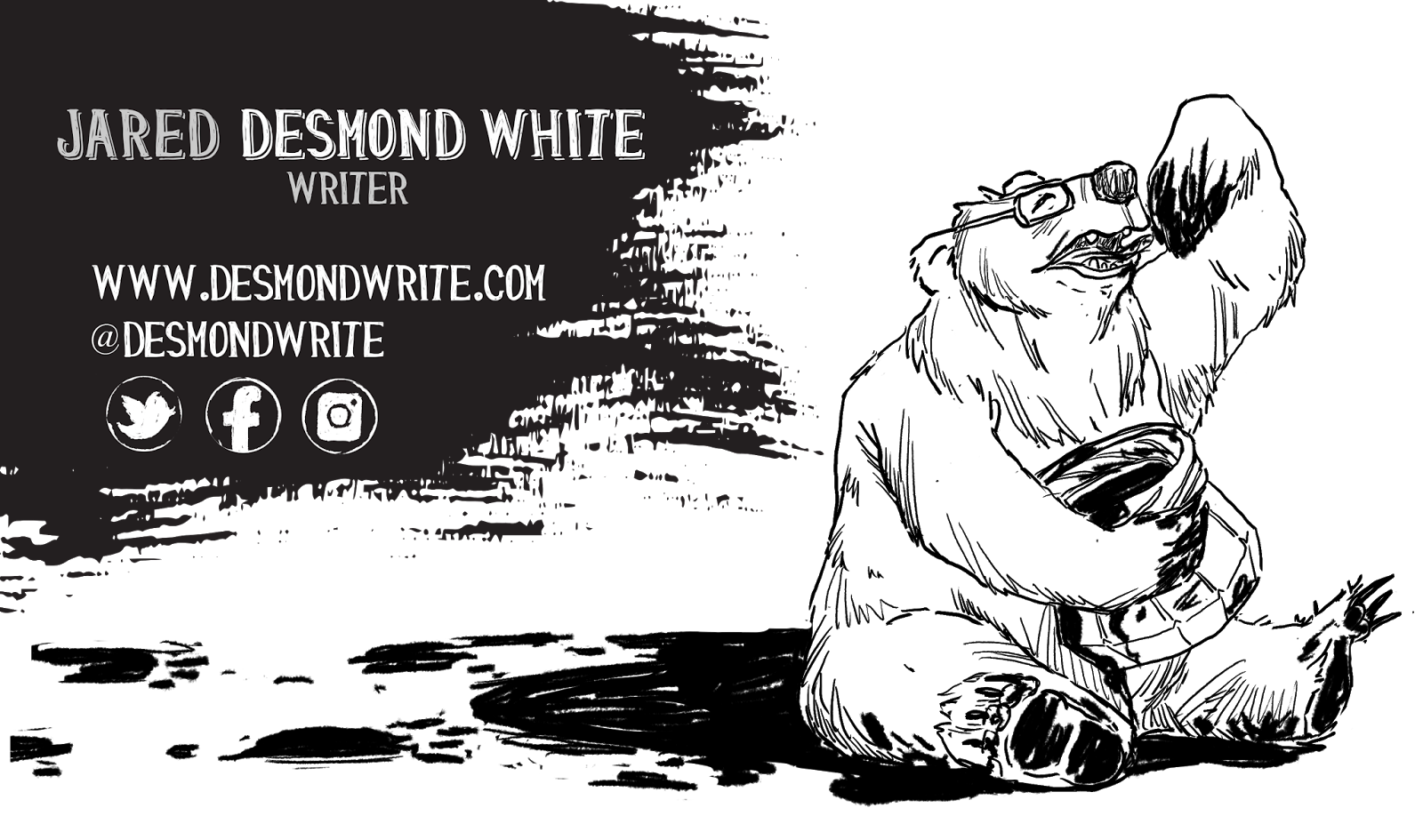
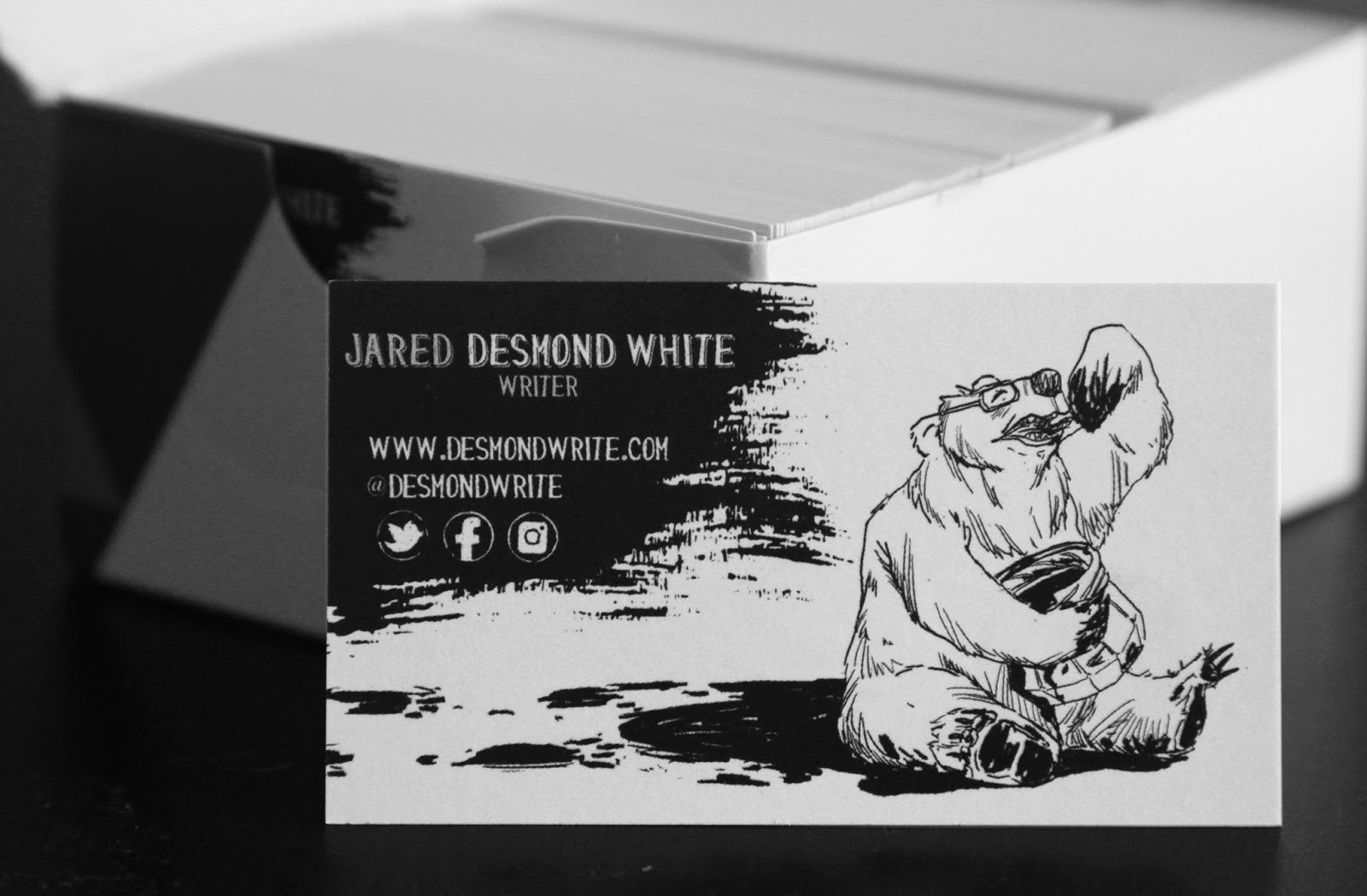
I commissioned my friend Phil Kiner (check out his Behance, Twitter, and Instagram) to make an official business card for Desmond, Write.

Originally, I was thinking the card should feature the California Flag Bear made of the night-sky, like this:

It was elegant (that’s Phil’s mock-up), but Phil pushed me to find a design that better represented my personality. Something writerly, sophisticated, sloppy. Finally, we envisioned what would become the final result: a bespectacled bear eating ink like Winnie the Pooh and spilling it everywhere. It was my spirit animal. It was me.

And when Phil sent me the final proof, I was not disappointed.


The Front

The Back


If you’re looking for a professional graphic designer or an artist-in-general, Phil should be your go-to guy. Phil’s currently accepting commissions and can be contacted at pbkiner@gmail.com.

Don’t be a crap hatch. Do it.

Life, Writing Process

First post about Writ in Water

This past week I opened the submission period for Houston Baptist University’s debut literary journal Writ in Water. The submission period started on the 8th of November (i.e. on the same day as the US Presidential Election), will conclude on the 8th of February, 2017, and the journal will be published digitally on May 1st. Writ will be accepting short stories and poetry, and although the publication is affiliated with a Christian college, the submissions will not have to be religious in nature. Instead, Writ’s editorial board is seeking literature that combines good writing and the human experience.

Writ is the result of months of deliberate planning and meetings, but I have wanted to start a literary journal for a long time – since childhood, in fact, when I first read an issue of The New Yorker and wondered about the lives of editors-in-chief. When I began working as the Writing Coordinator of HBU’s Academic Success Center, I realized that my life goal could also benefit the college community, especially its emerging writers and artists. The Success Center, after all, doesn’t only serve struggling students with their grades – success comes in a variety of forms, including publication.

The Academic Success Center and HBU Administration were very supportive of the journal. My conflict was naming the thing. Trouvaille, which is French for a lucky find or discovery by chance, was considered, along with Numinous, a word that means a strong spiritual moment or the presence of divinity. But Writ in Water had three aspects which won out in the end:

Aspect One) On Mount Sinai, as recounted in the book of Exodus, Moses received two tablets of covenant law. These Laws were God-writ and therefore eternal. From this we have derived the idiom “nothing is written in stone” to signify that nothing else is permanent, perpetual, or predictable.

Aspect Two) The phrase “writ in water” comes from John Keats’ deathbed request to not include his name on his gravestone. Instead, the young feverish poet who “foresaw his death with brutal clarity” wanted only the mysterious line: “Here lies One Whose Name was Writ in Water.”

Aspect Three) The Bible, too, has a context for water, as God’s Word, as God’s Intervention, as the Holy Spirit. Isaiah 44:3 says that God will “pour out water on the thirsty lands and streams;” Corinthians 12:13 that “we were all baptized into one body… we were all made to drink of one Spirit;” and Jesus says in John 3:5 that “no one can enter the kingdom of God unless they are born of water and the Spirit.” Appropriate metaphors for a Baptist institution.

From these wells I draw my inspiration.

Reference

Stacey, Michelle. “Writ in Water: The enduring mystery of Keats’s last words.” The Paris Review, 23 February 2016.

Fantasy

Opening Pages of Iron Abbie

This was a fantasy manuscript that I was working on that sadly remains incomplete.

A bird landed on the sill and cheeped. It was a pretty thing, mostly brown with a few blue and yellow feathers like scales on a fish. Abigail sat very still and peered over, not wanting to startle it, and noticed that the poor bird had a padlock stuck on its head—the metal hook, like a curled finger, wrapped around its neck. The padlock was small and silver and it gave the bird a noble look, but it was obvious the bird was suffering. Perhaps it had come for help?

“Don’t move,” said Abigail, and she ran about the house, finally returning with a coterie of keys. The bird stood patiently while she applied the metals, but none fit. Not the one to mother’s jewelry-box, not the one that looked like a skeletal finger, not the golden one for the shelf beneath the peering glass, not the one to father’s desk. Finally, Abigail went down into the foyer and with some hesitation pulled the key to the front door from her father’s spare coat. It was shaped like an F and it fit into the padlock. Liberated, the bird flew out the window, soaring over bowler hats and stone heads to the park across the road. From a branch it looked back, then was gone.

Continue reading

Satire

A list of exhibitions the Museum of Modern Art would probably display

A wall coated in Bubble-wrap with a Do Not Pop Sign. All the bubbles have been popped.

A year’s worth of poops in grocery bags. Each is titled with what the artist ate that day. For example: Desmond White, “eggs, mushrooms, enchiladas, side of salsa, aspirin, 18 ounces of water,” Nov. 7, 2016.

A wall-sized plaster vagina with live feminists inside spurting passerby with super soakers full of goats blood in a modern comment on silencing the lambs of lady periods.

A window that’s been labeled “window” or “panels.” A mirror that’s been labeled “reflections.”

An armchair made out of dicks been done

A labyrinth of waist-height cardboard walls been done

A video of people making out and rubbing fish on each other been done

A pile of straws been done

A rabbit made out of rabbit turds been done

and finally

A beautiful baroque portraiture done in the style of Rembrandt with a caption that reads: “The artist wanted to upset the popular notion that modern art has to be shit.”


Life

Six Word Memoirs

Every year, I have my students introduce themselves by writing and sharing six-word memoirs. The guidelines are simple. An evocative, original story in six words. These memoirs don’t have to be a narrative, but they must be biographical and significant. With my students’ permission, I publish them anonymously in SMITH Magazine’s Six Words on a profile that’s slowly becoming a catalog of high school woes. Here are a few of my favorites:

Always super hungry. Always super eating.

Die laughing at your own dying.

Caring but still no one cares.

Dreams go up. Rain comes down.

Always stressed and never well dressed.

So many achievements, so little recognition.

Daydreaming to find my future endeavors.

First day of school, have homework.

My mind – brighter than my future.

Napping and I’m not even sleepy.

School today takes my life away.

I have wasted perfectly good wrists.