Satire

Fiction — “The Other Borges”

Author’s Note (For Context): This is a ficción, inside joke, eulogy, parody, and testament to the translator and writer Jorge Borges, in imitation of his excellent “Tlön, Uqbar, Orbis Tertius.”

I owe the discovery of a Borgesian doppelganger to the conjunction of a mirror site and an entry on Wikipedia. The mirror troubled the depths of my thoughts in my suburban home in Sugar Land, Texas; the Wiki-page was devoted to an author with a similar name, another Borges. My friend had been explaining the utility of a mirror site, a website replica created to divert network traffic, when, in jest, he said that mirrors and copulation were abominable, since they both multiply the numbers of men. The phrasing seemed too eloquent for his invention, and I asked who had said it. Jorge Borges, was the reply. A strange sense of unreality set in, and I asked if he had any relation to the Argentine writer of the same name, to which my friend said – I don’t think so.

We set about to search for this Borges on the Internet, but could find nothing, only webpages saying Page Not Found, since my Wifi wasn’t working. To save face, he searched again on his phone, but could only find the other Borges – the magical realist from South America. Again, he distanced the quote’s origin and this literary master, arguing that they were separate persons. I finally decided this had been a fruitless fiction derived from my friend’s pride and insecurity in claiming the passage for his own. Surely, if there had been two Borgeses, I would have heard of this anomaly, this controversy?

Years later, I would find a book by this alt-author in a used book store on 99. The work was titled The Garden of Forking Paths, and contained a slew of stories, all strange and wonderful and infinitesimally complex. I was leaving the store when in the Spanish aisle I saw the name Borges in bold print. It was on the cover of El jardin de senderos que se bifurcan – clearly, the work of the Original Author. I bought both works and brought them to my home for careful examination, or to use a word discounted by high school teachers, to peruse. What I found was astonishing. The two texts, by two authors of the same name, were completely unrelated in regards to content. In fact, one was incomprehensible, written in a language divergent from ours: Spanish. Yet the structures were identical, or nearly so, for both had Tables of Contents, chapter headings, a body of pages, a foreword and index. And the stories corresponded; their paragraphs and even their punctuation were terribly homogenous. I felt as if I’d found some otherworldly Rosetta Stone, some fragment of twin dimensions.

The pictures of the authors in the book jackets looked related, although one was much older, shrewder, with a drooping eye. They could have been twins, if it weren’t for the gap in years, or duplicates, as if God had multiplied Soul and Body – some error in creation buried beneath the continuities.

My final discovery was on the bookshelf of a woman I was wooing. She was a graduate student renting her professor’s small one-bedroom apartment while he was on sabbatical. There was an erotic nature to our connection, accentuated by strange phallic images the professor had put up on the walls. African tribal spears, bolo knives, and near-nude women with large breasts in Picasso-like frontality. On her shelf, or rather, the professor’s shelf, was a copy of Borges’ Forking Paths. One night, I brought my own copy from home (possibly by the same author, possibly by the Other) and compared the two. What I found led to my utter distress and subsequent destruction of the books. The works were the same and not the same, as if the two writers had plagiarized the same source, some ur-text, or precursor. In one book, the words read, “I have known that thing the Greeks knew not – uncertainty.” The other: “I have known uncertainty: a state unknown to the Greeks.” Both, despite distance, derivation, offered a glimpse into the unrealness of my world – its labyrinths, its mirrors.

I struck a match which burned like the sun above me, and put it to the books. For a moment, I thought there were twin suns crackling in the afternoon heat, before the bookfire rescinded, leaving behind its ashy droppings, a clutter of black fragments belonging to the libraries of Hell.

Fantasy, Life, Writing (Published)

Published — “Familiar Girls”

My microfiction “Familiar Girls” was published by Blood Song Books in “Curses & Cauldrons.” Their witch-based anthology boasts “over 200 tiny dark tales of magic, mischief, murder, mayhem & madness” and is available as an ebook or trade paperback. I’m proud to be published alongside so many great writers, including my wife!

Oh, and here’s a great review of the anthology.

Fantasy, Life, Writing (Published)

Published — “The Other World Tree”

My flash fiction, “The Other World Tree,” was published in Quail Bell Magazine. Inspired by stories set in Victorian London and the Upside Down in Stranger Things, I wrote a two-page story about a girl’s encounter with a dimension that’s not benevolent or wondrous.

Quail Bell Magazine is a literary magazine that finds and publishes seriously good writers (I should know, I’m one of them). Founded by Christine Sloan Stoddard, Quail Bell seeks “real and unreal stories,” especially stories that are “imaginary, nostalgic, and otherworldly.”

As they say in their motto:

Our go-to spell? Art + Ideas = Magic.

Life, Scifi, Writing (Published)

Published — “Water Bees”

Flame Tree Publishing included my gothic horror story “Water Bees” in their Gothic Fantasy print anthology Detective Thrillers. The anthology of murder mysteries combines classic and contemporary writers, so my work is featured alongside G.K. Chesterton and Arthur Conan Doyle.

“Water Bees” follows an elderly police inspector named Henri Monreau as he hunts through Arles, France, in search of a missing entomologist. In case the city sounds familiar, it’s where Vincent Van Gogh painted some of his most famous works and then went mad. What makes this story unique, and a tad above the typical, is the world concept—Henri lives in an alternate universe where there are only bugs and humans. No squirrels, deer, fish, birds, just ants, beetles, spiders, and people, who are theorized to be an advanced form of worm.

Flame Tree Press is a London-based publishing company that’s generally interested in science fiction, fantasy, horror and crime fiction, but also dabbles in artisan notebooks, illustrated calendars, cards, jigsaw puzzles, and other gift-friendly forms. Founded in 1992, the press’s self-described purpose, to quote Pablo Picasso, is to wash “the dust of daily life off our souls.”

Life

Rejection Letters of 2019

Although teaching is ridiculously time-consuming, I still try to write on the side. Here are the rejection letters I received over the course of 2019. Some of these works ended up being published later. Others were blogged or tossed into some backwater folder, never to be unearthed again.

Also, let me be clear. I do not harbor any of these magazines any ill will. Rejection is a constant in any writer’s attempts at a literary career. There’s breathing, there’s eating, and there’s a monthly rejection letter in the inbox.

Continue reading

Life, Scifi, Writing (Published)

Published — “Birdu Vanilla”

365 Tomorrow published my scifi microfiction “Birdu Vanilla.” The story is a reflection on senseless gaming but don’t confuse me for a ‘video games make you hurt people’ right-winger ignoring the rightful causes of gun violence. I’m more of a flightless bird who’s too fat to fly. You’ll notice the comments are more forgiving than my last piece on 365.

Justifiably so.

365 Tomorrows is an online journal that publishes speculative fiction every single fething day. The site is an excellent complement to your morning bowl of cereal and glass of Moloko Plus.

Life

The Novel I wrote when I was Ten — “Old Endings”

Today we finish a hundred pages of literary abandon.

When I was ten, I wrote The Hero on Foot: The War of the Bowl. It was a fantasy travesty, an attempt at fascinating narrative by an immature writer that ended in drivel. You can start from the beginning by going here.

But we’re done. This is my last post on THOF:TWOFB (huh, not as catchy as LOTR) covering the final chapters.

Thank the gods there never was a sequel.


Chapter Eight

Our ‘hero on foot’ has come a long way. Javis has befriended wizards, slain knights with silly names like Sir Venice and Sir Treacle, been healed by a pontificating ogre, ordered a ‘hot squirt’ in a cathedral dedicated to cats, and tossed an urn into the face of his deadliest foe, then beheaded the guy.

But now Javis has to deal with something even stranger.

A fight between a demon and a zombie.

Continue reading

Life

The Novel I wrote when I was Ten — “The Only Fucking Battle in the War of the Bowl”

The Hero on Foot: The War of the Bowl is a trash book. Every page, every sentence, every word. Trash. And I can say that because I’m the book’s writer (in my defense, I wrote the abomination when I was ten). The manuscript is a compilation of every overused fantasy trope bound by poor syntax and grammar. Want to start at the beginning? Go here.

Today we will look at the only battle in the promised ‘war of the bowl.’ Spoiler. The battle is trash.


Chapter Six

A recap. Our hero is chilling in a cathedral. His mentor is hanging out in a cave. The villain is unconscious, carried around by his friends.

So basically nothing is happening.

But this chapter isn’t called “The Battle” for nothing.

Continue reading

Life

The Novel I wrote when I was Ten — “The Cathedral of Cats”

This is Part III of the book I wrote in middle school. If you want to start from the beginning, go here.

In 1999, when I was ten, I wrote a book. It was called The Hero on Foot: The War of the Bowl and it was the worst thing ever written. Some twenty years later and I’ve recovered that particular manuscript from my parent’s attic—and out of my immense generosity, I’ve decided to review, summarize, and post excerpts for your general amusement.

The book was a poor imitation of Lord of the Rings with the One Ring to Rule Them All replaced by kitchenware. Tolkien’s decision to use a ring makes sense. A ring is ceremonial, has intrinsic value, can represent the union of souls, has a sense of permanence and significance. Today, we wear rings to show our devoted love, or alma mater, or sport’s team, or membership in a secret society. A bowl? I guess you use it to eat cereal.

There’s a delight in watching bad movies. I hope y’all will equally enjoy bad literature.


Chapter Four

If you’ve missed the story so far, all you need to know is that our hero is badly injured and lost in the woods. That’s really all you need to know. Seriously.

Javis Kyle is discovered by an ogre named Lars. Apparently my ogres are smart, compassionate creatures.

And this is what ten-year-old-me thinks smart people sound like:

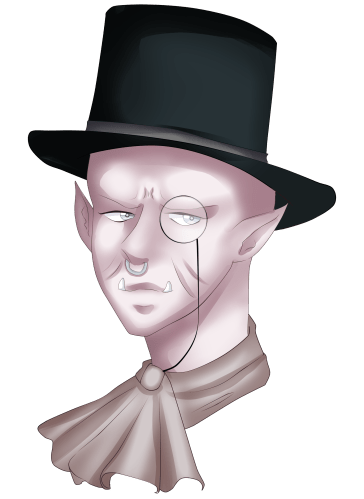
By the way, Lars is dressed like a gentleman scholar. I hired an artist to recreate this.

Continue reading

Life

The Novel I wrote when I was Ten — “A Wizard with a Beard for a Robe”


This is Part II of my summary of the book I wrote in middle school. If you want to start with Chapter One, go here.

In Several Short Sentences About Writing, Klinkenborg says every good writer starts with a good sentence. They write a good sentence, then write another. But there isn’t a single, decent string-of-words in The Hero on Foot: The War of the Bowl. Even the title chonks like a basketball-sized cat.

But that’s why we’re here. Not to read literature, but to laugh at ugly prose. The following is the first book I ever wrote.

Enjoy?


Chapter Two

First, a recap. Our hero’s family is dead, his village destroyed. Okay, recap over.

We find our protagonist living in the woods Into the Wild style.

Is it?

Is it cool?

I imagine my fifth grade teacher writing “cool” like John Oliver says “dope.”

(John Oliver also has an unimpressed “cool” but the gifs were too grainy.)

Continue reading